Breed profile
Golden Comet
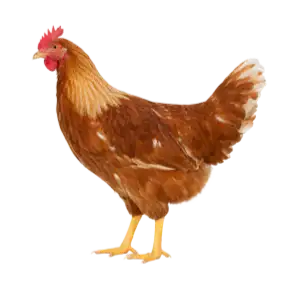
The red sex-link built to fill a basket. The cross traces to a New Hampshire Red male over White Rock or Rhode Island White hens, with the Hubbard firm as originator, and the hatcheries sell the same idea under a shelf of trade names — one Golden Buff page lists Golden Comet, ISA Brown, Cinnamon Queen, Red Sex Link and Red Star as names for its line. One of the big three sells 'Golden Comet' by name and builds its line from a Cherry Egger male over Rhode Island White hens, insisting its Golden Comet is not its Cinnamon Queen. The names don't resolve neatly; the production does: hatchery estimates run 250-320 brown eggs a year, with about 330 on the breed reference. Day-old pullets hatch reddish-gold and cockerels pale, so the sexing is visible at the mailbox.
The egg numbers
| Eggs per year (first laying year) | 250–330 |
|---|---|
| In-lay rate | ≈5–6 a week |
| Strain note | One spec table: 250-320. The breed reference: about 330, at up to 6 eggs a week. Another line: 260 Large Brown. The Golden Buff page — which lists Golden Comet among its names — claims 395 in the first 72 weeks of lay. |
| Egg color | brown |
| Egg size | large |
| Starts laying | 17–20 weeks |
Body and climate
| Form | standard |
|---|---|
| Strain | hybrid cross |
| Comb | single |
| Leg feathering | clean |
| Leg color | yellow |
| Distinguishing features | sex-linked chick colors: pullets hatch reddish-gold, cockerels pale or white · not an APA-standardized breed — a crossbreed |
| Skin color | yellow |
| Mature hen weight | 4 lb |
| Mature rooster weight | 6 lb |
| Weight note | One reference: 1.81 kg hens (4 lb), 2.72 kg cocks (6 lb). Hatchery specs run heavier — 5-7 lb hens and 8-9 lb roosters on one table, 5-6 lb combined on another — so the hybrid plainly has no standard weight. |
| Cold hardiness | good |
| Heat tolerance | good |
| Climate note | The hatchery page grades the line Cold and Heat Hardy; the breed is adaptable, thriving in both hot and cold weather, but the single comb is susceptible to frostbite. |
Character
| Temperament | Laid-back, relaxed, and amiable by breed description. One hatchery line: docile, calm, friendly. The Golden Buff runs active and dominant with what its page calls a quiet temperament. |
|---|---|
| Broodiness | rare |
| Broody note | One sex-link table says 'not at all likely', the Golden Buff page lists Broody: No, and females do not usually show broodiness; one hatchery alone grades its line Variable. |
| Good first breed | Yes |
What this means for your setup
Small, efficient birds — about 4 pounds on the reference standard — with hybrid feed conversion to match. The trade-offs are the usual production-hybrid ones: they're bred to spend early, broodiness is graded rare to non-existent (plan on an incubator if chicks are the goal), and the single comb takes frostbite in hard freezes, worth remembering in Minnesota-style winters. The Golden Buff page notes the line thrives free-range; another calls its birds great foragers.
Gear that fits this breed
Coop Size Calculator
turn 4-lb hens into coop, run and roost numbers
Egg Calculator
turn the 250–330 egg-a-year range into a hen count
Golden Comet FAQ
How many eggs do Golden Comets lay a year?
One spec table estimates 250-320; the breed reference says about 330 at up to 6 eggs a week; another line is rated at 260 Large Brown. The Golden Buff — which its page lists as a Golden Comet alias — claims 395 in the first 72 weeks of lay.
When do Golden Comets start laying?
The Golden Buff page lists laying maturity at 17-20 weeks; some birds start as early as 16 weeks. Both are earlier than most standardized breeds.
Is a Golden Comet the same as an ISA Brown?
Hatcheries use the trade names differently. One page lists Golden Comet among the names for its Golden Buff (an ISA Brown line); another's Golden Comet is its own proprietary cross — Cherry Egger male over Rhode Island White hens — and that hatchery states plainly that its Golden Comet is not its Cinnamon Queen. All are red sex-links; the parent stock varies by hatchery.
Do Golden Comets go broody?
Rarely. One sex-link table grades broodiness 'not at all likely', the Golden Buff page lists Broody: No, and females do not usually show broodiness.