Best Solar Chicken Coop Doors (2026): What Survives Winter
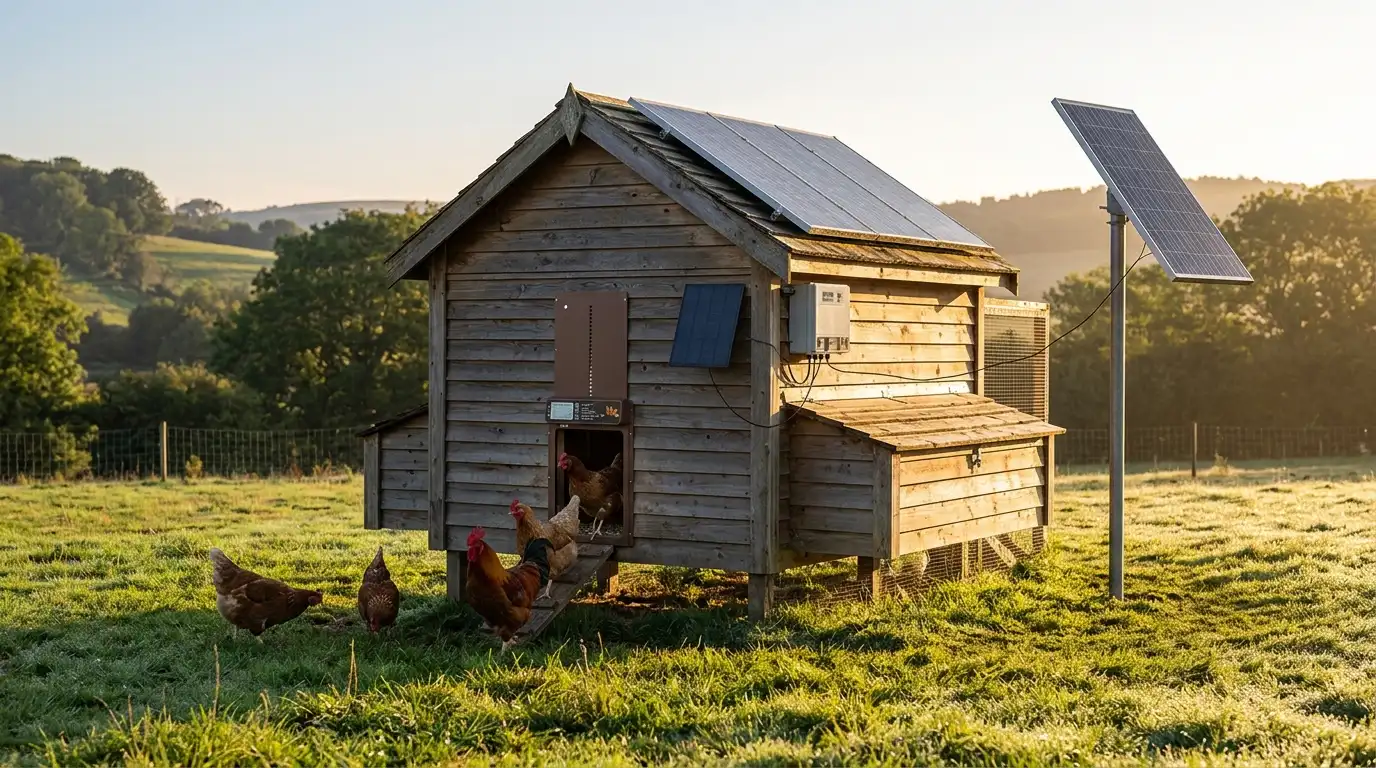
There is a walk every keeper of a far coop knows. Headlamp on, out past the garden, down to the shed at the property line, just to see whether the door actually closed.
If that is your walk, this page is for you.
If your coop sits within cord reach of an outlet, this page is also for you, but the answer is one paragraph long. Skip solar. Run a cord or a mains kit, and spend the difference on a better door. The main automatic door guide covers those properly.
This page is about the coop at the end of the yard, where the cord does not reach.
Here is the order: who solar is for, the physics that decides it, the three brands selling solar doors in the US right now, and the winter evidence that matters more than any spec sheet.
Who solar is for
The case starts with a wall outlet, or the lack of one. If a cord can reach the coop, you do not have a solar problem. You have a batteries-or-mains question, and the main guide already answers it. The Omlet Autodoor runs on AA cells or a mains kit. The Run-Chicken T50 runs roughly a year on two AAs. Both are simpler than any solar arrangement, and neither one depends on the weather.
Solar earns its keep in three situations.
The genuinely unwired coop: a pasture shelter, a shed at the property line, a run extension where trenching power would cost more than the coop did.
Battery dread: a door that dies at dusk leaves the flock unlocked all night. A keeper who knows they will not keep a battery calendar is being realistic, not lazy, when they want the door to feed itself.
Cold: batteries lose capacity in freezing weather, at exactly the moment the door matters most. A panel topping them off daily can beat a twice-a-year swap in a hard-winter town.
Now the against column. If the coop sits in tree shade, on the north side of a building, or anywhere the winter sun arrives low and brief, the panel cannot do its one job. No brand fixes geography.
If you want live status over WiFi, know that the radio, not the motor, is what drains the battery. Cold-climate keepers reporting sagging solar doors keep finding that the connection drops first, and plugging the unit in is what rescues it.
And if you are considering solar because it sounds like the premium tier, the price cards below are the cure.
Solar is for a coop with sun and no outlet. Everything else is a battery question.
The physics: a door is the one coop gadget solar can run
Here is the arithmetic that decides the whole question. A door motor runs for a couple of seconds, twice a day, and sleeps the other twenty-three hours and fifty-nine minutes.
That tiny duty cycle, spread across a full day of charging, is exactly the profile solar handles well.
A coop heater is the opposite: hundreds of watts, drawn continuously, through the coldest and darkest weeks of the year. It is the profile solar handles worst. That is why our heaters guide steers you away from solar heaters and toward safe low-wattage units on mains power.
A door motor runs for seconds a day. A heater runs for months. Same word on the box, opposite physics inside.
Winter is still the stress case, and it stacks three problems into one season. The days are shortest, so the charging window narrows. The cold derates the battery, so less of every charge is usable. Ice and packed snow raise the force the motor needs to break the door free.
The makers have started designing for this openly. ChickenGuard ships a Winter Mode that pushes extra power to the motor in cold months. Run-Chicken’s Eternal has a Power Mode that increases motor force to shove through ice, snow, and debris. When you compare doors, those modes are the spec worth reading, more than panel wattage.
The three doors, and what the prices actually say
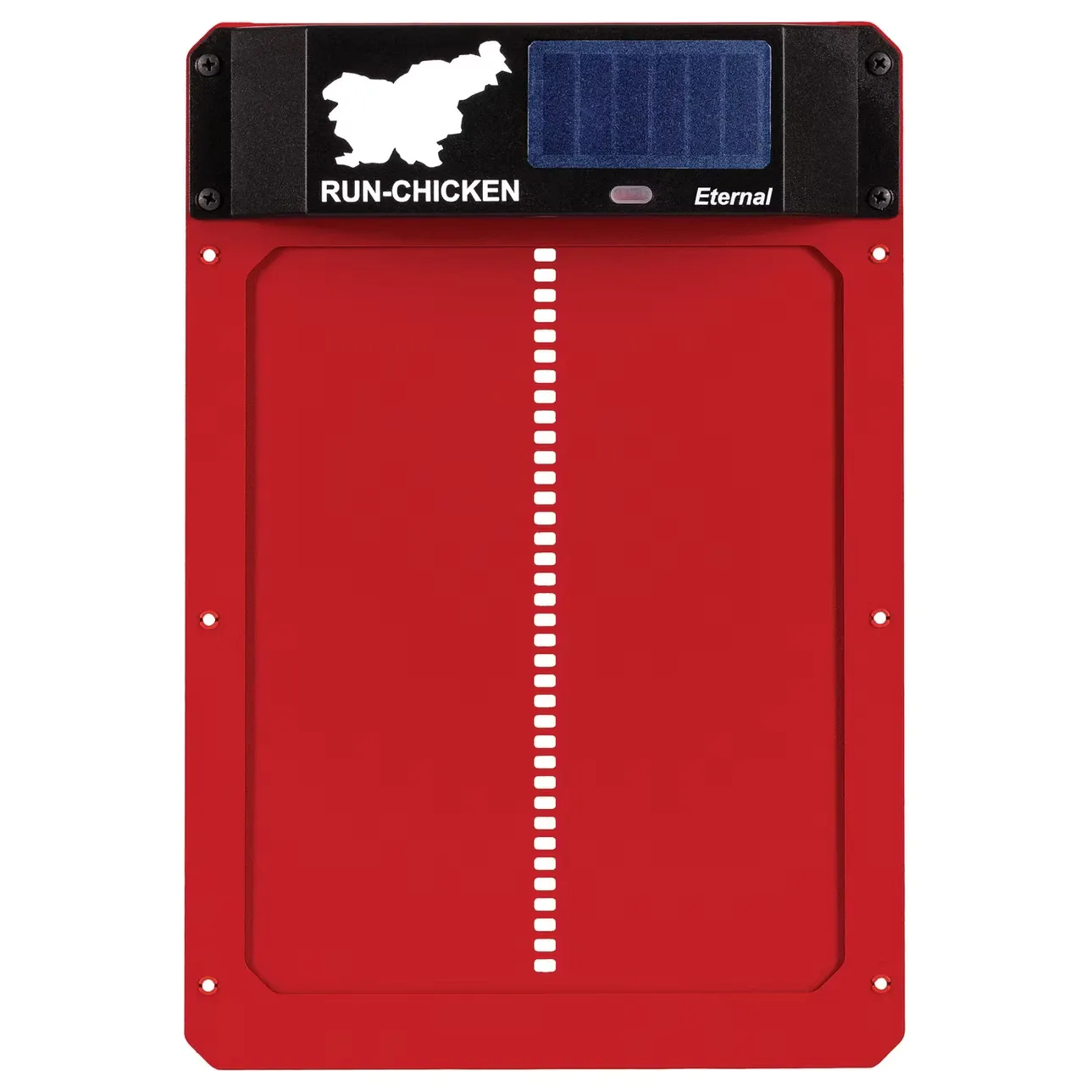
Run-Chicken Eternal
at Run-Chicken- Panel
- built into the drive unit
- If the sun fails
- rechargeable cells; battery gauge in the app
- Cold weather
- Power Mode shoves through ice and snow
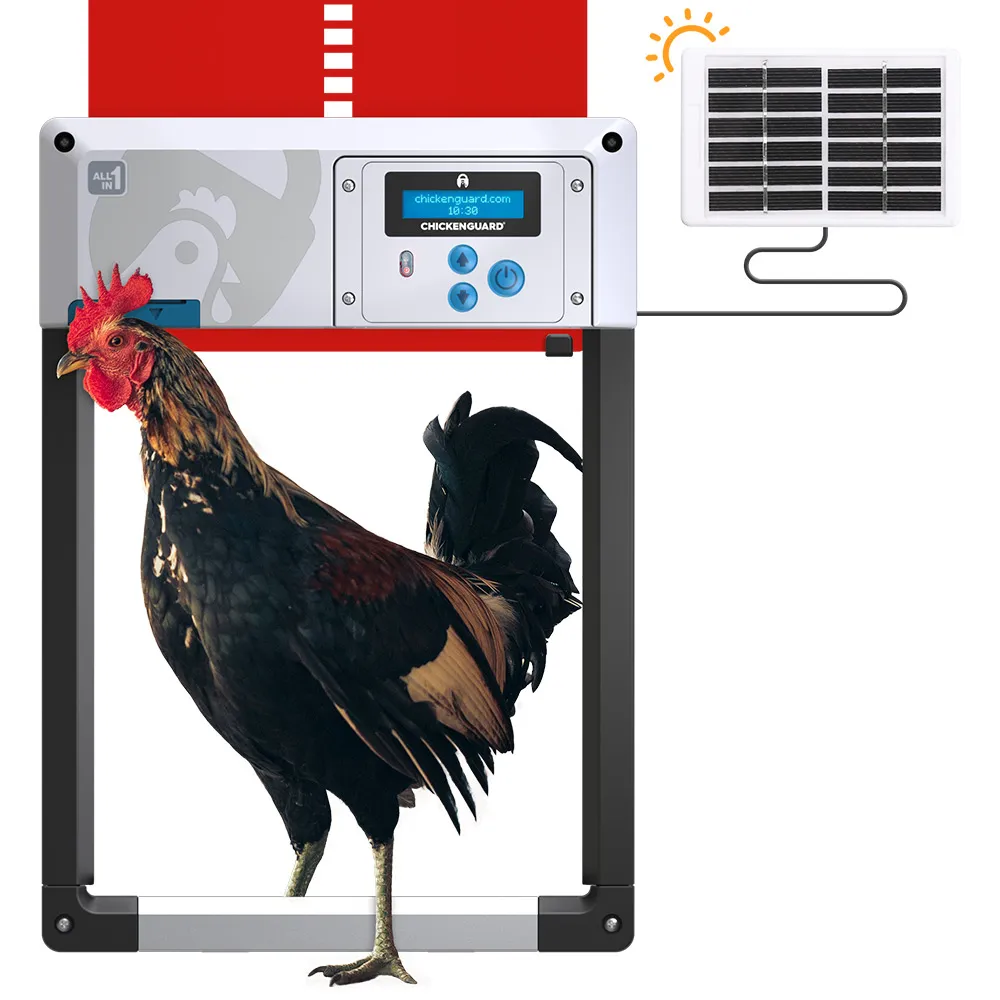
ChickenGuard All in One Solar
at ChickenGuard- Panel
- separate panel on a cable
- If the sun fails
- 4×AA or a 9V adapter
- Cold weather
- Winter Mode, minus 4 °F rating, 3-year warranty
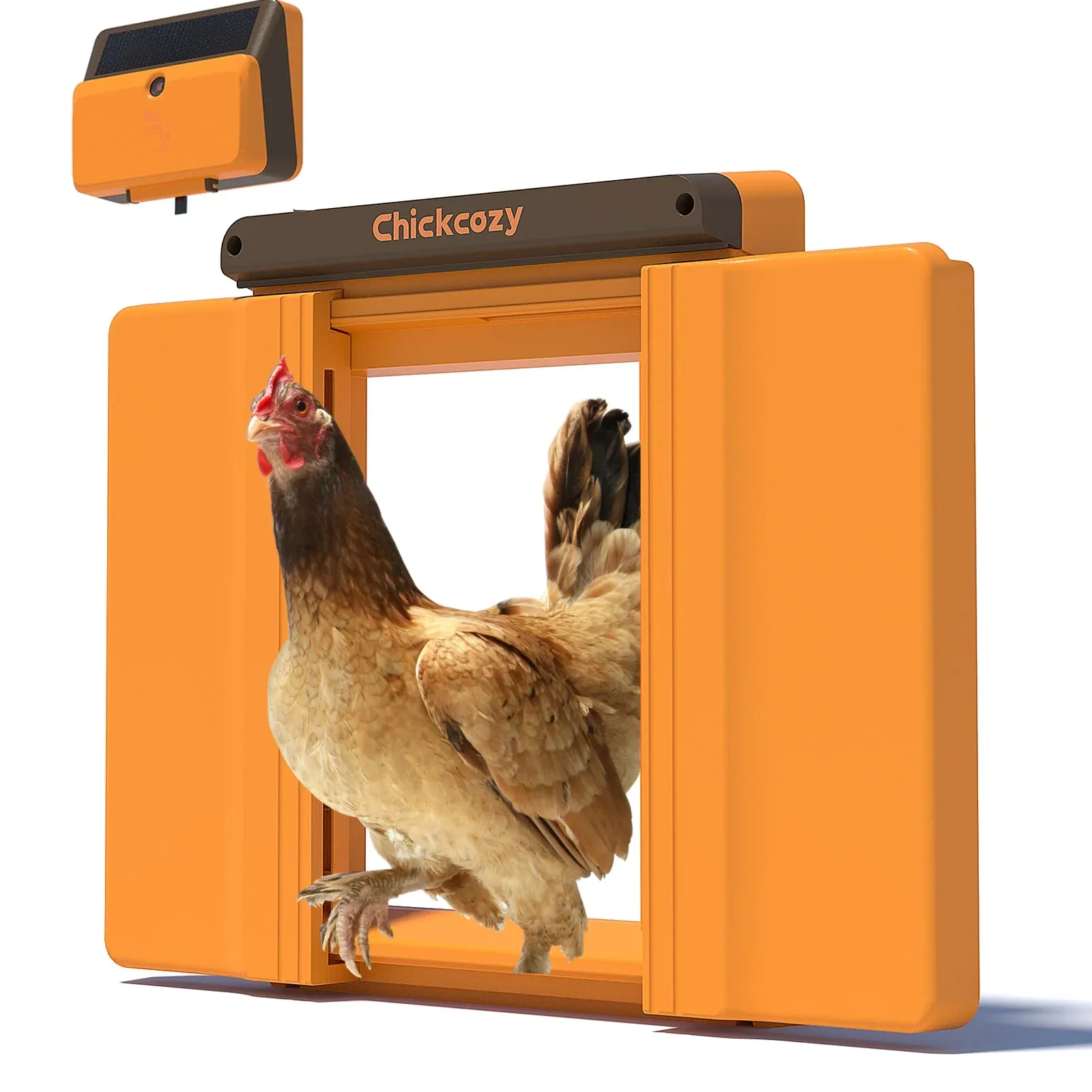
Chickcozy Solar Door
at Chickcozy- Panel
- wired to a control box
- If the sun fails
- nothing documented on the maker's page
- Stock
- out of stock at the November 13 check
Prices are the ones on each maker’s own page, checked on November 13, 2026. Stock moves, especially this season, so treat the cards as a starting point and verify before you buy.
Stock is part of the answer this season. On the day I checked, ChickenGuard’s solar line was 25 percent off and all three core units were in stock; its red and blue All in One variants were not. Chickcozy’s only door was out of stock entirely. The cards are a map of what these doors cost, not a promise that the price holds or that you can buy one today.
Look at the prices and one structural fact jumps out. At list, solar costs ten to twenty dollars more than the battery version of the same door, and one brand has stopped selling the battery version at all.
On sale in mid-November, the arithmetic flips. ChickenGuard’s complete solar door at $127.49 undercut the battery T50 at $129.90. Solar stopped being a premium tier and became a checkbox, and this month it is a cheap checkbox.
Sale prices are temporary, so the long-run decision is still not financial. It is whether your coop has sun, which is where this article started.
Run-Chicken Eternal: the T50 with its own power plant
The Eternal is the T50 chassis with a solar cell built into the control unit: same aluminum door, same 8 by 10 inch opening, same anti-pinch behavior that stops and reverses when it meets resistance, plus a motor-locking system so nothing lifts the door by hand at night.
Twenty dollars over the battery door buys the panel and a set of rechargeable cells. It does not buy a different door.
The app shows the battery level, which turns a dead-battery surprise into a slow, visible decline you can catch months early.
Two honesty notes from a close read of the official page.
The solar section says the cells should last more than five years before replacement under normal conditions. The care section of the same page says to replace them about once a year. I cannot reconcile those sentences, and you should not trust either one over the app’s own gauge.
And the control philosophy carries over from the T50: no physical button, so the paired phone is the only manual override. Our head-to-head guide flags the same hole, and it matters most for anyone whose pet sitter does not carry a smartphone.
Here is the honest way to think about the twenty dollars. If the panel sees four hours of December sun, it is the best twenty dollars in this category. If it does not, the panel is decoration and you have bought the T50 with a slower battery.
Details and current price on Run-Chicken’s official page.
ChickenGuard: the one with a lifeboat
ChickenGuard sells solar three ways. The All in One Solar at $169.98 is the complete door unit. The Pro Solar opener at $159.98 automates the door you already own. The Pro Kit Solar at $189.98 pairs the opener with their aluminum door.
The reason to look hard at this line is the power architecture. Every unit runs on the solar panel and rechargeable cells. It also accepts four AA batteries, ships with a set of alkalines so the door works before the sun has done anything, and takes a 9V adapter as a third path.
This is the only line here where a solar failure degrades into a battery door instead of a dead one.
The catch, for most of October, was stock. On November 13, all three core units were in stock again, and the line was 25 percent off: $127.49 for the All in One, $142.49 for the Pro Kit, $119.99 for the Pro Solar opener. The red and blue All in One variants were still unbuyable. Availability on this brand has wobbled since early October, so watch the shop page rather than trusting any roundup’s snapshot, this one included.
Winter-specific, the units carry a Winter Mode for cold months, a working range down to minus 4 Fahrenheit, and a 3-year warranty.
At list you are paying twenty to forty dollars more than the Eternal for a fallback you may never use. At the sale price on November 13, the Pro Solar opener was $119.99, thirty dollars under the Eternal, and it still has the AA lifeboat. In a dark climate, that is the cheapest insurance in the category.
Current models and stock on ChickenGuard’s official page.
Chickcozy: solar-only, and thin paperwork
Chickcozy went the other direction from everyone else. The brand sells one door, it is solar-only, and the old battery version is gone.
At $159 it undercuts the field. The maker’s store showed 4.5 stars across 247 hosted reviews when I checked on November 13, and the official page promises dawn-to-dusk light-sensor operation with no batteries and no wiring.
There is one catch that changes the buying advice: the door was out of stock on that same check. Single variant, no color choice, nothing to ship. A price that undercuts the field does not help if the listing says sold out.
What the official page does state is a 3,200 mAh built-in battery and a charge-one-day, last-for-a-week promise, a few sentences above its own no-batteries bullet. What it never states is what that means when the sun does not show up. The store banner promises a 2-year warranty on all products.
The independent comparison I read describes an external panel on a six-and-a-half-foot cable feeding a separate control box with timer, light-sensor, and manual buttons. That is a sensible architecture.
But a marketing promise is not a published reserve spec, and after four cloudy December days this maker, alone in the group, gives you nothing to check against.
Every other maker here publishes a fallback plan. Chickcozy publishes a light sensor.
Current specs on Chickcozy’s official page.
If you already own a Run-Chicken
Run-Chicken sells a $29.90 USB-C solar panel built for its Giant coop door, plus an Eternal upgrade drive unit that brings the solar running gear to their other doors.
The panel only fits the Giant, which narrows the audience. But it is the cheapest solar conversion in the category, and everything said above about sun exposure applies to it double.
The cheapest conversion is also the one with the least margin for a shaded yard.
One product page, two climates
The best winter evidence I found on this subject sits on ChickenGuard’s own product page. I want to be straight about what it is: hosted reviews, curated by the maker, sixty-one of them at a 4.8 average on the All in One Solar.
Two of those reviews, both five stars, disagree with each other in the most useful way.
Douglas, keeping birds in Wyoming, describes a week at minus 4 degrees where the door “never skipped a beat.”
Brittany, somewhere colder and darker, still gave five stars but wrote that it is “just too cold here for the solar for it to work like I need it to.”
Same door, same rating, opposite outcomes.
The split is not build quality. It is the difference between a Rocky Mountain winter, which is brutal but sunny, and a high-latitude winter, which is merely cold and dark for months.
If your December looks like Douglas’s, solar is viable and this class of doors will hold. If it looks like Brittany’s, the AA fallback inside that same ChickenGuard unit stops being a nice extra. It becomes the actual working system, which is exactly why the lifeboat architecture earns its premium.
Freezing rain convicts the wrong defendant
A keeper on the BackYardChickens forums reported their Run-Chicken door’s electronics working fine at minus 19 degrees. After an ice storm, the door refused to move, because ice had bonded the panel to its frame.
That is not a battery failure or a solar failure. It is a seal the motor has to break, and it is what Power Mode and Winter Mode actually exist for.
The battery was innocent. The ice was the lock.
If your winters feature ice storms, weight that mode heavily and keep the door frame clear, the same way you keep the run roof from loading up with snow. The rest of the cold-season checklist is in our winterizing guide and the cold-climate coop guide.
A solar door is not a door that cannot fail. It is a door whose failure arrives as a slow, visible decline instead of a cliff, and only if you actually look at the gauge the app or the indicator gives you.
Put a glance at the battery level on the same weekly walk as the water check, and the physics will hold up its end. When to swap batteries, and the other nine ways an automatic door fails in a real winter, are in our automatic coop door problems guide.
The verdict
Buy solar if your coop is out of cord reach and your winter sun is real.
The Eternal at $149.90 is the cleanest implementation in the class: an integrated panel, an aluminum door, and a battery gauge you can watch. It is my pick for unwired coops in sunny-winter states.
Buy the ChickenGuard solar line if you want the lifeboat. The AA and adapter fallback is worth real money in a dark climate, and on November 13 the 25 percent sale made it the value pick in the class: $127.49 for a complete solar door, $119.99 for the opener that solarizes one you own.
Chickcozy at $159 is defensible on price and ratings. I would want the maker to publish a reserve spec before trusting it as the only thing between a February night and an open pop hole, and it was out of stock on November 13, so the price is theoretical until the door returns.
Skip solar, cheerfully, if an outlet can reach the coop. Mains power or a yearly AA swap is simpler than weather-dependent charging, and the money difference is a takeout dinner.
Already own a Run-Chicken door? The thirty-dollar panel question is a Giant-owner question, and the upgrade drive unit covers the rest of that line.
One market note heading into the season: the Black Friday banner that carried no discount in late October had turned into a real 25 percent cut by November 13, and the solar class now lists between $149.90 and $189.98 before the sale. If the discount holds, it will be on our deals page. I do not predict how long a sale runs.
FAQ
Do solar coop doors work on cloudy days?
For a stretch, yes, and the battery buffer is what decides how long. Run-Chicken’s page claims the Eternal’s cells should go years between replacements under normal sun. An independent comparison of the class cites one full day of sunlight running the Chickcozy for a week, and a handful of sunny days covering the Eternal for a year. Treat every number like that as marketing until your own first January checks it. The spec that actually answers the question is reserve capacity, and only some makers publish it.
What happens when a solar door runs out of power?
The same thing as any battery door: it stops where it is. Stopped open at dawn is an inconvenience. Stopped open at dusk is a flock unlocked overnight, which is why the gauge deserves a weekly glance. The difference is the decline profile. A solar door gives you weeks of falling readings first, and on the ChickenGuard line you can fall back to AAs or an adapter while you sort out the panel situation. On a solar-only door with no documented fallback, a drained battery means the door is down until the sun returns.
Can I add a solar panel to the door I already own?
Only within the Run-Chicken family, officially. Their $29.90 panel fits the Giant door, and their Eternal upgrade drive unit brings solar running to the rest of that line’s chassis. Omlet offers no solar option for its Autodoor, ChickenGuard sells its panels as part of the solar units rather than as add-ons for older openers, and Chickcozy is solar-only to begin with. Owners do build DIY 12V panel setups for other doors, and those threads are fun reading, but a homemade power rig on a warranted door is a bet you are making alone.
10 Automatic Chicken Coop Door Problems You Should Avoid
Cold snaps, frozen tracks, bad light sensors, and missing manual buttons: ten automatic chicken coop door problems you can run into and how to avoid them.
Run-Chicken T50 Review (2026): One Opening Size Decides It
The T50 runs a year on two AA batteries and needs an 8 by 10 inch opening with 24 inches of clear travel above it - the specs, and who should skip it.