Breed profile
Black Sex Link
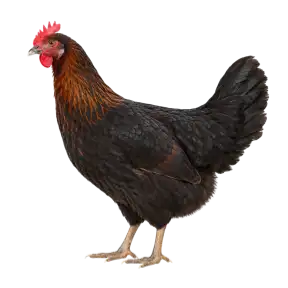
The brown-egg workhorse of the sex-link family. The standard cross is a Rhode Island Red rooster over a Barred Rock hen — one hatchery states it and says it has run that parent stock since 1992, and the others agree. Sold under the Black Star and Black Sex Link trade names, the cross announces each chick's sex in the down: pullets hatch almost all black, cockerels wear a white head dot. Production is the point: estimates run 200-280 brown eggs a year and 250 on another table, and the big hatchery tables grade egg production 'best'.
The egg numbers
| Eggs per year (first laying year) | 200–280 |
|---|---|
| In-lay rate | ≈4–5 a week |
| Strain note | One spec table: 200-280. Another line: 250 Large Brown. A third: 5+ eggs a week. Sex-links can top 300 with excellent care — we publish the hatchery spread rather than the best case. |
| Egg color | brown |
| Egg size | large |
| Starts laying | 20–24 weeks |
Body and climate
| Form | standard |
|---|---|
| Strain | hybrid cross |
| Comb | single |
| Leg feathering | clean |
| Leg color | black |
| Distinguishing features | sex-linked chick down: pullets hatch almost all black, cockerels with a white head dot · not an APA-standardized breed — all sources classify it as a hybrid cross |
| Bird size | large |
| Skin color | yellow |
| Weeks to maturity | 18 |
| Mature hen weight | 6 lb |
| Mature rooster weight | 8 lb |
| Weight note | One spec table prints 6 lb hens / 8 lb roosters while its own prose says 'a little over 5 lbs' at maturity; another line runs 6.5/8; a third 6-7/8-9. The hybrid has no standard, so the spread stands. |
| Cold hardiness | excellent |
| Heat tolerance | good |
| Climate note | One table grades cold tolerance excellent and heat good; another credits the single, tight comb — 'hardy in both cold and warm climates' — and a third lists Cold and Heat Hardy. |
Character
| Temperament | Active and easy to manage on one table; friendly and calm on another. One hatchery page compares the temperament to a Barred Plymouth Rock. |
|---|---|
| Disposition | excellent |
| Free range | good |
| Meat production | better |
| Broodiness | rare |
| Broody note | Every table agrees: 'not at all likely', 'No', 'Non Setter', 'Rarely' across the four. |
| Good first breed | Yes |
What this means for your setup
Mid-to-large birds — spec tables run 6 to 6.5 pounds for hens — so roost and doorway math sits a notch above the light hybrids. Broodiness is a non-issue across all four sources, which makes them a laying flock, not a hatching one. One hatchery notes it carries two Black Star lines (one black with a red chest, one barred with a grey chest) and can't take requests between them; both are proprietary crosses. Another grades the line a willing forager.
Gear that fits this breed
Coop Size Calculator
turn 6-lb hens into coop, run and roost numbers
Egg Calculator
turn the 200–280 egg-a-year range into a hen count
Best Coops for Cold Climates
a cold-excellent breed earns the winter-spec picks
How Much Space Chickens Need
heavy fowl are the reason the generous end of the space math exists
Black Sex Link FAQ
How many eggs do Black Sex Links lay a year?
One spec table estimates 200-280 a year; another line is rated at 250 Large Brown eggs; a third promises 5+ eggs a week. The best-kept lines can top 300.
When do Black Sex Links start laying?
One hatchery lists laying maturity at 20-24 weeks; another's FAQ puts its Black Stars at 22-24 weeks. Either way, first eggs land later than the fastest red sex-links but earlier than most heritage dual-purpose breeds.
Is a Black Star the same as a Black Sex Link?
Yes — 'Black Star' is the common trade name for the black sex-link cross, and hatcheries sell the same bird under both names. The parent cross (Rhode Island Red over Barred Rock) is the part to check, since each hatchery keeps its own line.
Do Black Sex Links go broody?
Rarely, and every source agrees: the tables read 'not at all likely', 'No', 'Non Setter' and 'Rarely'.