Best Roll-Away Nesting Boxes, Re-Rated: What 'Up to 45 Hens' Actually Means
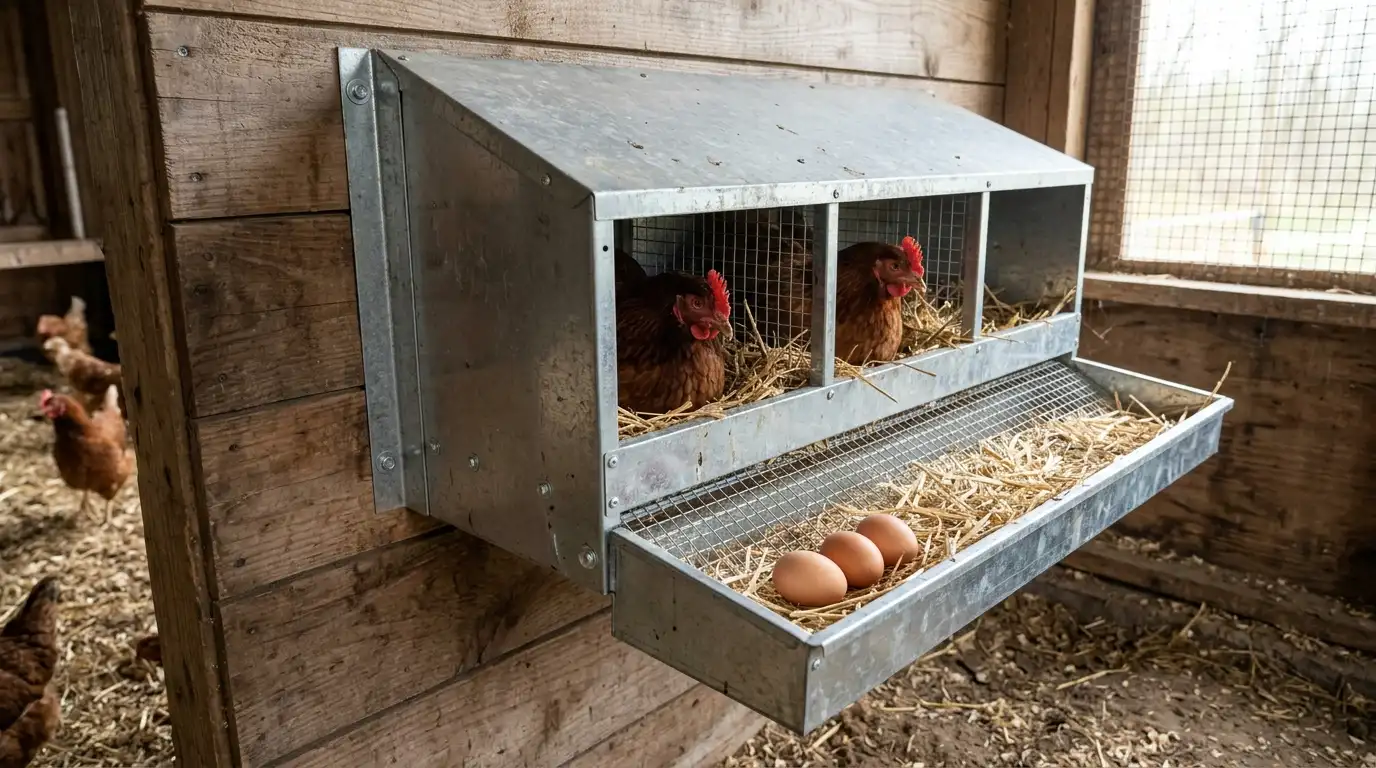
A two-hole metal nest box claims 22 hens. A three-hole box from another maker claims 10 to 12, and costs less.
Eleven hens per slot against four, and only one of those numbers survives the 12-inch standard the extension service works from. It is not the one on the bigger box.
I went down this hole because my four hens became eight in one spring, and eight hens sharing one nest corner means dirty eggs and a lot of straw.
The shopping advice I kept finding repeated the numbers printed on the boxes. Almost nobody checked them. So I read the spec sheets on every major metal box, pulled the claims off each official page in one afternoon, and ran the same re-rating math I used on coop capacity claims.
The width math is fine. The hen counts are marketing. And one sentence, printed in a product listing, explains the whole gap.
Here is the order: what a roll-away box buys and costs, that sentence, the re-rated table, four boxes worth buying, colony vs segmented, the install details that decide whether any of it works, and who should skip the category.
In a hurry: four boxes, four jobs
Best budget: VEVOR 6-Compartment, $105.90. Six 10.4-inch holes, legs included, and the only budget box whose printed claim survives the extension ratio. Skip it if you keep heavy breeds. Check the current price.
Best buy-once: RentACoop 3-Hole Suite, $159.99. Claims 10 to 12 hens for three holes, slightly under what the slot math allows. Reversible for front or rear collection, curtain included. Skip it if the flock is still growing. Check the current price.
Best open colony: EcoNest Colony Box, $211 on sale, $240 list. 46.5 inches of open floor from a farm supplier, and the maker that prints “not all at once” beside its own number. Skip it if you have a bully and a bottom hen. Check the current price.
Best steel, if that is what you want: HenGear Small, $195 direct. G-90 galvanized, US assembly, hinged back, spare pads sold separately. Its “up to 20 hens” is really eight to ten, so buy it for the metal. Skip it if you are shopping by hen count. Check the current price.
One box is missing on purpose. Best Nest Box does not publish a hen count or a price on the page I checked, and I come back to that below.
What a roll-away box buys and costs
A roll-away or roll-out nest box has a floor sloped a few degrees toward a collection tray. The egg rolls away from the hen within seconds of being laid, and you collect from the tray instead of reaching under a sitting bird.

What that buys you is concrete. Eggs stay clean because they leave the bedding fast. Breakage drops because hens do not stand on them. Egg eating gets harder because the egg disappears from view, and a hen cannot eat what she cannot see. Your daily check becomes a ten-second tray grab.
What it costs you is just as concrete. You lose the broody option, because a slope plus a tray means a hen cannot settle on a clutch. Keep at least one flat box if you plan to hatch.
The boxes also cost real money, they mount semi-permanently, and hens have to learn them. One buyer on Premier1’s own review section: “Took the chickens about 3 days to really start laying in it.” That matches every forum thread I read. Expect a week of floor eggs, not a day.
The one sentence that explains every claim
Here is the sentence, printed in Premier1’s own benefits list for the EcoNest Colony Box:
“Accommodates up to 45 hens (throughout the day, not all at once)”
Read it twice. The company is telling you, in parentheses, that its hen count is a daily traffic number. Forty-five hens might each visit the box at some point in the day. It is not a statement about how many can use the box at 9 a.m., when everybody wants the same corner.
Hens lay in a window of a few hours. They pile into preferred spots, and the favorites are the ones that get dirty and crowded. A throughput number is not a capacity number.
The extension standard is a capacity number. An answer out of Darke County, Ohio from 2015 puts it in one line: “Plan on one box per four or five birds.”
A second extension answer from 2023 repeats the same ratio and never mentions days at all. That is the ratio I re-rate against, same as in my capacity claims write-up.
And here is the part that made me laugh.
Premier1’s HenGear page claims “up to 20 hens” for a 24-inch box. One screen down, the same page’s tips section says: “We recommend one laying space for every six hens.” One page, two numbers, a factor of three apart. When the seller’s own advice column disagrees with the seller’s own claim, you know which one to plan around.
How the re-rating works
The math takes two minutes and you can check every row:
- Standard guidance gives each hen a 12 by 12 inch nesting space, four to five hens per box.
- Slots come from the maker’s own count on divided boxes, or usable width divided by 12 on open colony boxes.
- Honest capacity is slots times four to five birds.
- The inflation ratio is the claim on the box divided by that honest capacity.
- Claims and prices come from each maker’s official page on November 12, 2026.
The re-rated table
| Box (official page, 11-12) | Slots | Claim on the box | Honest at 4-5 per slot | Claim divided by honest | Price |
|---|---|---|---|---|---|
| VEVOR 6-compartment, legs included | 6 | 30 (5 per hole) | 24-30 | 1.0-1.25x | $105.90 |
| RentACoop Suite, 3-hole | 3 | 10-12 | 12-15 | 0.7-1.0x | $159.99 |
| EcoNest Colony Box, open | ~4 (46.5 in) | 45 | 16-20 | 2.3-2.8x | $240 (sale $211) |
| VersaNest 2-hole | 2 | 22 | 8-10 | 2.2-2.8x | $168 |
| VersaNest 4-hole | 4 | 45 | 16-20 | 2.3-2.8x | $250 ($234 on their comparison table) |
| HenGear Small, 24 in | 2 | 20 | 8-10 | 2.0-2.5x | $195 direct, $218 at Premier1 |
| HenGear Medium, 34 in | 3 | 32 | 12-15 | 2.1-2.7x | $295 direct |
| HenGear Large, 48 in | 4 | 50 | 16-20 | 2.5-3.1x | $334 direct |
| HenGear X-Large, 72 in | 6 | 75 | 24-30 | 2.5-3.1x | $445 direct |
Three things jump out.
The pattern from coops repeats. Capacity claims that move, move up. Nobody inflates down. The only two rows at or below the extension ratio, the VEVOR and the RentACoop Suite, are the ones that survived my check.
Cost per honest hen is not what the price tags suggest. The VEVOR works out to roughly $3.50 to $4.40 per honest hen. Everything else in the table runs about $10.50 to $28 at the listed prices.
The premium boxes pay for galvanized gauge, US assembly, hinged backs, spare pads, and a phone number that answers, which are real things. Capacity is not one of them: at four to five birds per slot the expensive 24-inch box houses the same eight to ten hens as the cheap one.
Check slot width before count. The VEVOR’s honesty on hen count comes with 10.4-inch holes, under the 12-inch standard. Fine for Leghorns and medium breeds, tight for a Brahma or a Jersey Giant.
If your birds are big, measure the opening, not the overall box, because overall width includes walls and trays a hen cannot lay in. Same lesson as the coop space guide, and the coop size calculator runs that arithmetic for the whole coop.
Four boxes hold up after the math, and they are four different answers to the same question. The order runs from the cheapest honest capacity to the most expensive, with the two mid-priced boxes close enough that layout decides.
1. VEVOR 6-Compartment — best honest capacity on a budget
The VEVOR is the cheapest honest capacity I could verify. $105.90 on the official page on November 12, with a claim printed per hole: “Each hole holds eggs from up to 5 hens.”
What you get
- Six holes, 10.4 inches each, in two rows of three
- Legs included, so the box stands free of a wall
- 31.3 by 20.67 by 38.98 inches overall
- Plastic floors on a galvanized frame
That works out to 30 hens on the box and 24 to 30 by the extension ratio, so the claim survives the math at the lowest price in this guide. At $105.90, that is roughly $3.50 to $4.40 per honest hen.
What you give up is fit and finish. Those holes sit under the 12-inch standard, which is fine for Leghorns and most medium breeds and tight for a Brahma or a Jersey Giant. Those dimensions also mean real wall space, not a shoebox.
Watch out: if your flock runs heavy, measure the opening first. Ten and a half inches is a real constraint on a big hen.
Best for: six to twelve hens on a backyard budget, especially with medium breeds, where the money goes to slots instead of steel. Check the current price at VEVOR.
2. RentACoop 3-Hole Suite — the buy-once box
$159.99 for three holes, with a claim of approximately 10 to 12 hens that sits slightly under the 12 to 15 the slot math allows. That is the direction a claim should err.
The Suite ships reversible for front or rear collection, includes a privacy curtain, and comes from a maker whose single-hole Efficiency box claims four hens for one hole at $99.99, which is straight extension math with no caveat needed.
What you get
- Three holes, one hen each
- Reversible for front or rear egg collection
- Privacy curtain included
Three holes is also the ceiling. Past about 15 hens you need a second box or a bigger suite. Per honest hen the Suite lands at $10.70 to $13.30, roughly three times the VEVOR, and the difference buys the service line and the fit and finish rather than capacity.
Watch out: the three-hole cap bites if your flock is still growing. Buy the size you will need in two years.
Best for: ten to fifteen hens, and a keeper who wants one box to outlast the coop. Check the current price at RentACoop.
3. EcoNest Colony Box — the box that prints the honest caveat
The EcoNest is a 46.5-inch colony box from Premier1, $240 list and $211 on sale on November 12, and the one box here whose printed claim arrives with its own caveat.
What you get
- 46.5 inches of open floor, no dividers
- Colony layout, hens share the full width
- A claim of up to 45 hens, caveat printed
- $240 list, $211 on sale
The sentence is why it earns a pick. A company that puts “not all at once” next to its own biggest number is doing the buyer a favor, and it tells you the rest of the industry’s numbers are traffic counts too.
By slot math the floor is about four 12-inch spaces, or 16 to 20 hens, so the printed number runs 2.3 to 2.8 times the honest one.
What you give up is privacy and a place to hide. An open colony floor leaves a shy hen nowhere to go when the top bird wants the same corner, which is why the layout choice below matters. At $211 to $240 it also costs more per hen than the VEVOR.
Watch out: if you have a bully and a bottom hen, dividers are the fix, and this box has none.
Best for: sixteen to twenty hens in a calm flock, and anyone who wants a colony box from a farm supplier instead of a marketplace brand. Check the current price at Premier1.
4. HenGear Small — the steel you are actually paying for
The HenGear Small is the box people ask about, and the answer is uncomfortable. It claims up to 20 hens and holds eight to ten. $195 direct from HenGear, $218 at Premier1, which makes it 2.0 to 2.5 times its honest count.
What you get
- 24 inches wide, two holes
- G-90 galvanized steel, made in the USA
- Hinged back, so you open it from outside the coop
- Reversible tray and replacement pads sold separately
What the money buys is durability and access: a steel box you open from outside the coop, and pads you replace instead of scrapping the unit. For a permanent wall in a permanent coop, that is worth something the VEVOR cannot match.
The reviews split along that same line. The box runs 4.3 stars across 34 ratings, 28 of them recommending it, and the same page pairs a pad complaint with genuine love for the time it saves. Both are quoted in the install section. A Texas buyer’s one-line verdict is the caution worth keeping: “You will regret what you paid for this.”
The family runs 24, 34, 48, and 72 inches at $195, $295, $334, and $445 direct, with claims of 20, 32, 50, and 75. Run the math on any size and it lands between 2.0 and 3.1 times its honest count.
Watch out: the pad is the weak point in the reviews. Order a spare with the box and skip the argument later.
Best for: a permanent install where US steel and a service line are worth the premium, and you want to buy the box once. Check the current price at HenGear.
The box that won’t give you a number
Best Nest Box, the Texas maker whose 48 and 70 inch community boxes fill most YouTube coops, does not print a hen count or a price on the page I could verify, which is almost refreshing. It argues the design case instead, and the argument is worth reading before you decide between the two layouts below. It stays out of the table because I do not put unverified numbers in a table.
Colony or segmented: two different boxes
Every metal box in the table ships one of two ways, and some ship both.
A colony nest is one open surface with no dividers. Hens share the full width, crowd where they like, and the egg rolls from wherever it was laid. Best Nest Box makes the argument openly: “Our nests do not have any dividers! This community style nest design eliminates hens from crowding each other out.”
A segmented nest has dividers that cut the box into individual holes, one hen at a time, more privacy, fewer squabbles over the same spot.
The VersaNest listing states the choice in a sentence I wish every maker printed: “Use as a community nest (like our EcoNest Colony Box) or install the included dividers for a segmented nesting box (for shy hens).”
Which one you want is a flock question. Busy flocks with a pecking order problem do better segmented, because the bottom hen gets a closed door instead of a shove. Small calm flocks lose nothing to colony, and colony floors are easier to clean because there are no divider corners.
My own call for a backyard flock of six to ten: start segmented. You can pull dividers out later. Going the other way means buying or cutting dividers that fit.
The install details that decide everything
A sloped floor is a gravity machine, and gravity only reads level. Best Nest Box says it in one line: “for the roll away feature to work properly, the nest box should be both level and plumb.” A box mounted a few degrees off has eggs that stall mid-slope, roll sideways, or pile at the tray lip and crack.
Half the “eggs didn’t roll” forum posts I read trace back to a coop wall that was never flat. Carry a small level on install day. It costs less than one broken egg a week forever.
Bedding is the second discipline, and it runs backwards from a standard box. A standard box wants bedding; a roll-away wants it only as a training tool, then less and less of it. Deep straw absorbs the slope, so the egg nests in a hollow instead of rolling.
Start thin so the floor still feels familiar, then pull it back over the first week or two. The pad that ships with most metal boxes is the end state, not a bedding substitute to pile on top. The rest of the coop’s bedding picture is in the bedding guide.
The third is the pad itself. The most useful one-star review on Premier1’s HenGear page is a pad complaint: “The brown pad that goes in the box is what really sucks. It holds poop like a champ.” The most useful five-star, same page, same product: “Saves you so much egg washing time.”
Both people own the same box. Metal boxes with washable plastic pads are a hose-and-dry system, and the people happiest with them are the ones who accepted that.
Who should skip roll-away entirely
Three honest exits. If you want to hatch chicks, a roll-away cannot hold a clutch, so keep at least one standard box. If your flock is three or four calm hens and you check the coop daily anyway, a cheap plastic box and clean straw do the same job, and the premium buys convenience you may not need.
And if the coop wall is a weekend project that ended up out of square, fix the wall before the box, because a sloped floor on a crooked wall is a machine built to break eggs.
Which box fits your flock
Four boxes, four conditions:
- Six to twelve hens, tight budget: the VEVOR, and measure the hole width if you keep heavy breeds.
- Ten to fifteen hens, buy once: the RentACoop Suite, with the three-hole ceiling in mind.
- Sixteen to twenty hens in a calm flock, colony floor: the EcoNest, especially at the sale price.
- A permanent install and you want US steel: the HenGear, at whatever size the flock needs, bought for the metal.
One boundary holds for all four. None of them will hold a broody hen, and none replaces the one standard box you keep for hatching. If the eggs still will not roll, the problem is the wall or the bedding, not the box, and the install section covers both.
FAQ
How many hens per roll-away nest box hole?
Plan on four to five hens per 12-inch hole, the extension ratio, regardless of the number printed on the box. The one budget box whose printed claim matches this, five per hole on 10.4-inch holes, is honest on count and slightly tight on width. Claims of ten to twelve hens per hole are daily traffic numbers, not simultaneous capacity.
Do roll-away nest boxes stop egg eating?
They make it much harder. The egg rolls behind a barrier within seconds, and a hen cannot peck what she cannot see. Premier1’s EcoNest listing and Best Nest Box’s design notes both sell the feature on exactly this separation. It will not stop a confirmed egg eater from finding eggs on the floor or in a standard box elsewhere in the coop, so fix floor eggs too.
Can a broody hen use a roll-away nest box?
No. The sloped floor and collection tray are designed to remove eggs from under the hen, which is the opposite of what a broody needs. If you let hens set and hatch, give broodies a flat standard box or a separate broody area, and keep the roll-away for daily laying.
Omlet Eglu Cube Review: What $1,399 Actually Buys
Omlet's Eglu Cube starts at $1,399 with no run, needs no maintenance, rolls on wheels, and handles winter. It's our standout pick in its price bracket.

What Killed My Chickens? A Guide to the Five Ways In
Predators get in five ways: dig, reach, squeeze, drop in, or work the latch. Read the signs, match the fix, one weekend at a time.