Omlet Eglu Cube Review: What $1,399 Actually Buys
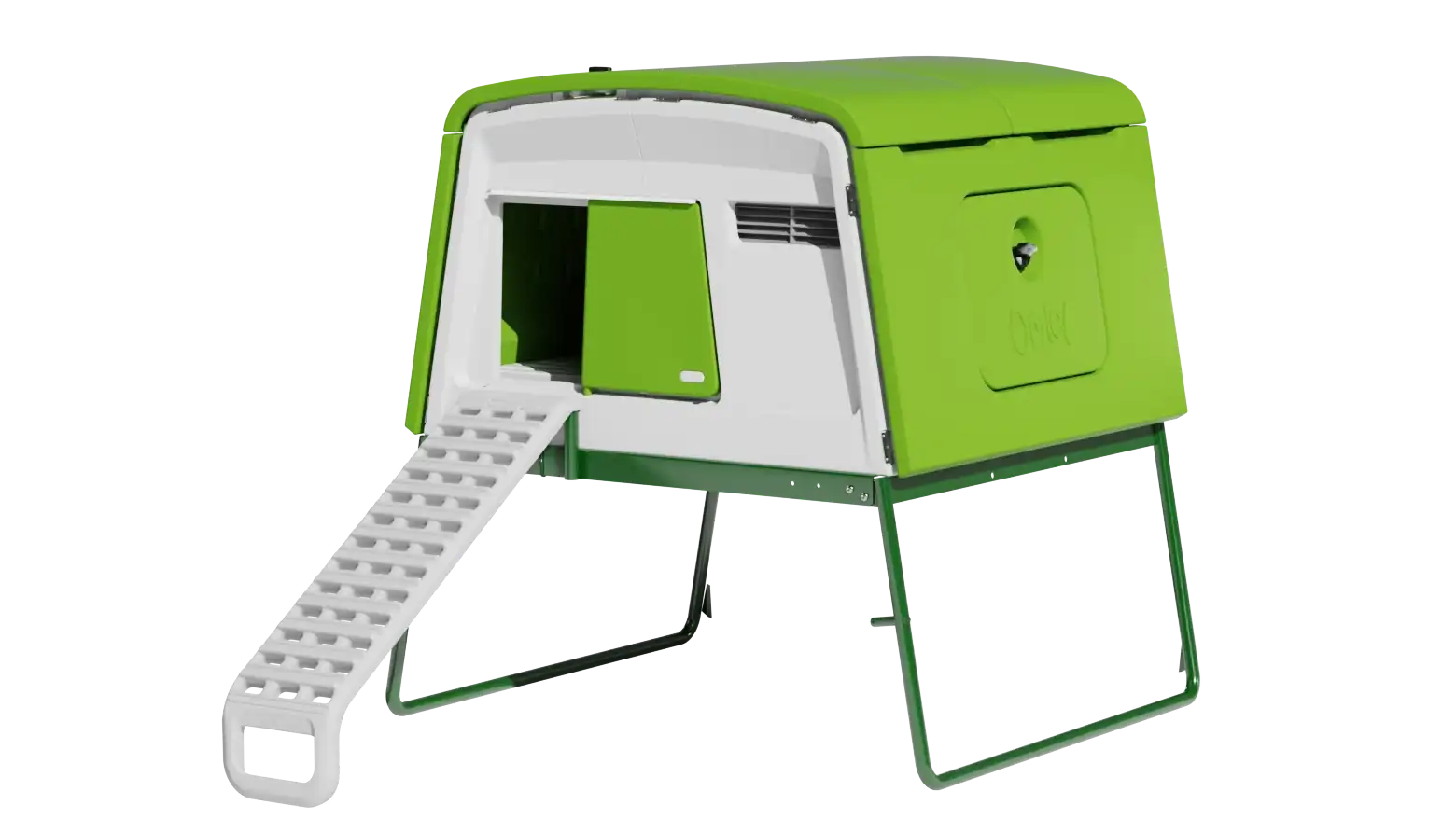
The Omlet Eglu Cube is the coop I couldn’t get past. When I went looking for a large coop, plenty of people pointed me at it.
What makes it worth the money, before the caveats:
-
Nothing to maintain. Seamless hollow plastic, no wood grain, and so nowhere for red mites to live. The twin-wall construction solves four problems at once: insulation, strength, moisture, and the absence of crevices. No amount of upkeep closes that material gap on a wooden coop.
-
Where the vents sit. The vents are above roost height, and the airflow is designed not to blow across the roosting area.
-
Modular, repairable part by part. The ten-year warranty covers every part, which matters more than the warranty headline: it means repairs are covered, and repairs are simple.
-
It moves. Most coops can’t. Rolling the whole thing onto fresh grass spreads the manure around the yard instead of concentrating it, keeps the run floor from turning to mud, and puts the flock on new grass every week. For the person who actually keeps hens, that’s the one that pays off every week.
“Up to 6 large hens”: the capacity claim, checked
The product page calls the Cube “the perfect size for up to 6 large hens, 8 medium breeds or 10 bantams.”
Here’s the floor math. The house measures 3 ft 3 in by 3 ft 1 in, about 10 sq ft of interior. Our standard is the strict top end of the university extension range, 4 sq ft of floor per bird. Ten divided by four is two and a half, call it three hens. Against a claim of six, the claim runs at double the strict floor math, which is the same pattern we found on every prefab coop in our capacity dataset.
Omlet publishes both areas, the interior floor and the 5 ft 1 in outside width once the nest bays are counted, and almost no maker does; only the inside number divides by four, and our space guide shows why the difference matters. And the Cube roosts birds on full-width bars above the floor rather than on it, which converts part of the floor requirement into perching room, while the run carries the daytime. That’s why our dataset’s real-world column for the Cube reads 5-6 standard breeds in practice instead of the strict three.
My read, sorted by how you keep them. Two or three hens living in the house-and-run full time: no problem. Four or five with daily ranging: comfortable. Six large hens is the edge of the claim, workable if the flock free-ranges most days and you accept a snug house at night. Six large hens that live in? Not this coop. The floor math won’t bend for a price tag.
One more angle on the same numbers. The 6 ft run package costs $1,699, which works out to $283 per hen at the claim’s own number, $340 at five hens, and $566 at the strict three. Per-hen math settles nothing by itself, but it’s the honest lens for a coop whose criticism is exactly about size per dollar.
Run your own flock through the standard with the coop size calculator. The Cube also holds the top slot in our six-hen coop guide, at these same re-rated numbers.
The winter claims: what a New England cold snap actually did
The winter claim is where this coop earns or loses its money, so I went and read the cold-country threads instead of trusting the marketing blocks.
Omlet’s pitch is twin-wall plastic: two-inch insulated panels, draft-free by design, vents that sit above roost height. No heat lamp required, which matches what we hold everywhere on this site: most coops don’t need heat, and dry bedding with airflow do the actual work.
The strongest record I found is a January cold-snap thread on Omlet’s own club forum, where a New England keeper posted this a week into sub-zero weather:
I am very happy to report with the sub zero temps we have been having here I have had NO PROBLEMS with the plastic of the cube (nor the eglu from last year) having any damage or cracks from the extreme cold of a New England winter.
Another keeper in the same thread reported a -18°C week with no cracking. For calibration, you’ll see the plastic described as tested to -10°C. That number traces to a forum moderator repeating it, not to a published spec.
What winter actually breaks isn’t the plastic and isn’t the hens. It’s the moving parts. Lids iced shut. A droppings tray frozen into its slides, until the only way in was to pry the roof off. Snow load on the roof shifting the panels enough to make doors stubborn. Our standing advice: clear even light snow. If you add a winter cover, keep the vents clear, because condensation and ammonia buildup “are both killers.” Ice weeks need a plan for the tray and the lid before they arrive, not after.
If your winters drop below roughly -25 to -30°C, the coop stops being the subject. Keepers where winters hit that hard move the whole setup into a shed or greenhouse for the season, and one northern-Swedish owner ran his Cube through two winters that way by design. If your Januaries look like that, buy for the shed plan, or buy a coop built to live indoors.
Omlet sells an extreme-temperature blanket to hold warmth in over winter. Our cold-climate guide rates the Cube the pick for real winters, with the same note I’d give here: in deep winter carry the practice number down from 5-6 birds to 4-5. The ventilation habits that keep plastic coops dry are covered in our winter ventilation guide.
Deep cleans in 10 minutes
The cleaning claim is the one that sold me fastest. The droppings tray slides out the back, and the whole thing tolerates a jet wash. This is why our six-hen guide made it the top pick on mechanics: the pull-out tray turns the twice-a-week chore into a two-minute job.
Winter is the asterisk. A tray frozen in its slides is not a two-minute job. That’s a January problem, not a design problem.
There’s a second half to cleaning, and it’s red mite. Mites need crevices. Wood gives them somewhere to live; plastic doesn’t. That’s why wood-coop owners spend spring weekends scrubbing seams while Cube owners jet-wash and go to bed. Over ten years that labor is real money, and it never appears in any price comparison.
“Predator resistant”: mesh and skirt
Omlet spends the most on predator resistance, and the specifics are better than most: heavy-duty welded steel mesh on the run, an anti-tunnel skirt around the base, and two-step locks that don’t open easily. The design logic covers the big three losses from our predator guide’s kill-pattern framework. A fox can’t chew through welded mesh. A digging dog or coyote meets the skirt. A raccoon, the cleverest of the three, meets a latch it can’t work open.
One thing to keep in mind: no coop sold today is weasel-proof. That said, the Cube covers the common threats as well as any design on the market.
The real price tag
“From $1,399” is the number on the page, and it’s real, but it’s also the most misleading number in this review. On Omlet’s own configurator the run selector starts at None. That $1,399 is the house by itself. The product title says “with Runs”; the base price doesn’t include one.
The first rung with a run attached is the 6 ft package at $1,699, so that’s the honest entry ticket, $300 above the advertised price. Every configuration below was in stock the day I checked.
| Configuration | What you get | Price (Oct 28) |
|---|---|---|
| 6 ft run package | House plus 6 ft run | $1,699 |
| 6 ft run, wheels | Above, on wheels | $1,849 |
| 9 ft run package | House plus 9 ft run | $1,849 |
| 9 ft run, wheels | Above, on wheels | $1,999 |
| 12 ft run | House plus 12 ft run | $1,949 |
| 12 ft run, wheels | Above, on wheels | $2,099 |
| 6x6 walk-in run | Stand-up run you enter | $2,699 |
| Walk-in bundle | Walk-in plus feeder and waterer | $2,749 |
The wheels tiers deserve a sentence. About $150 buys the ability to roll the whole coop onto fresh grass, and I’d pay it: the run system is half the reason to choose this coop, and a stationary run kills the lawn under it in a season.
The ecosystem stacks from there. The accessory most Cube owners end up wanting is the automatic door, $199 standard or $229 for the WiFi Smart version, which we’ve already put head-to-head with the Run-Chicken T50. The no-waste feeder runs $89 and the insulated waterer $109. A fully dressed Cube, meaning the 12 ft run with wheels, the Smart door, the feeder and the waterer, lands around $2,526 before tax. Hold that number in your head, not $1,399.
For scale, the same $1,699 as the 6 ft package buys OverEZ’s Medium, an Amish-built wood coop our guides rate around 8 hens. Nearly double the birds per dollar, and the maintenance ledger comes back: seams to seal, waterproofing to renew, mite seasons to survive. Which side of that trade you want is a values question, not a math question, and the six-hen guide has the honest wood picks if you land there.
One timing note if any of this is on a holiday list: the day I checked, Omlet’s own page carried a notice that current demand has orders on a waiting time. Order against the wait, not against the shipping estimate. Our Black Friday page tracks what these brands actually do when the discount window opens.
Most importantly: a ten-year warranty and a 180-day return guarantee. Spread across a decade, that’s the part that buys peace of mind.
Who shouldn’t buy it
Skip it if you’re budget-locked. At this money you’re buying a decade of not maintaining anything. If maximum birds per dollar is the binding constraint, wood holds nearly double the flock for the same spend, and a used shed conversion holds more still.
Skip it if you’re in true cold country. The owner record runs out and the forum consensus turns to sheds somewhere around -25 to -30°C. If that’s your January, buy for the shed plan.
Skip it if your flock is eight or more large birds. The claim itself tops out at six large hens. This isn’t your size, and pretending otherwise ends in a cramped coop and a re-run of this purchase.
Skip it if you’d rather build. Some of the loudest anti-Cube voices are keepers who would enjoy the build itself, $600 of lumber and two weekends, and that’s a real preference, not a wrong one. The buy-versus-build instinct is the same one our feeder readers wrestle with.
The verdict
Buy it if you’re keeping three to five hens in a small yard, you’d rather pay once than maintain forever, and your winters are real but not brutal. That’s the buyer this coop was drawn for, and for that buyer the claims mostly hold.
First, the capacity claim falls a little short of the page: six large hens is three hens by floor math, five with daily ranging. But the winter record is genuinely strong. As for the price tag, this is the cheap-to-own coop. It looks expensive up front, and then it saves you both money and effort for as long as you keep hens.
If you’re a lap earlier in the decision, start with how much space chickens need and let your flock pick the coop, not the other way around. The capacity checker runs the numbers for whatever you’re considering, and current Cube configurations are on Omlet’s page.

What Killed My Chickens? A Guide to the Five Ways In
Predators get in five ways: dig, reach, squeeze, drop in, or work the latch. Read the signs, match the fix, one weekend at a time.
Best Chicken Coop Bedding: What Each Bag Really Covers
Hemp, pine, straw, or pellets: coop bedding priced per square foot of coverage and per full fill, with the pine shipping trap most charts miss.