Best Chicken Coop Bedding: What Each Bag Really Covers
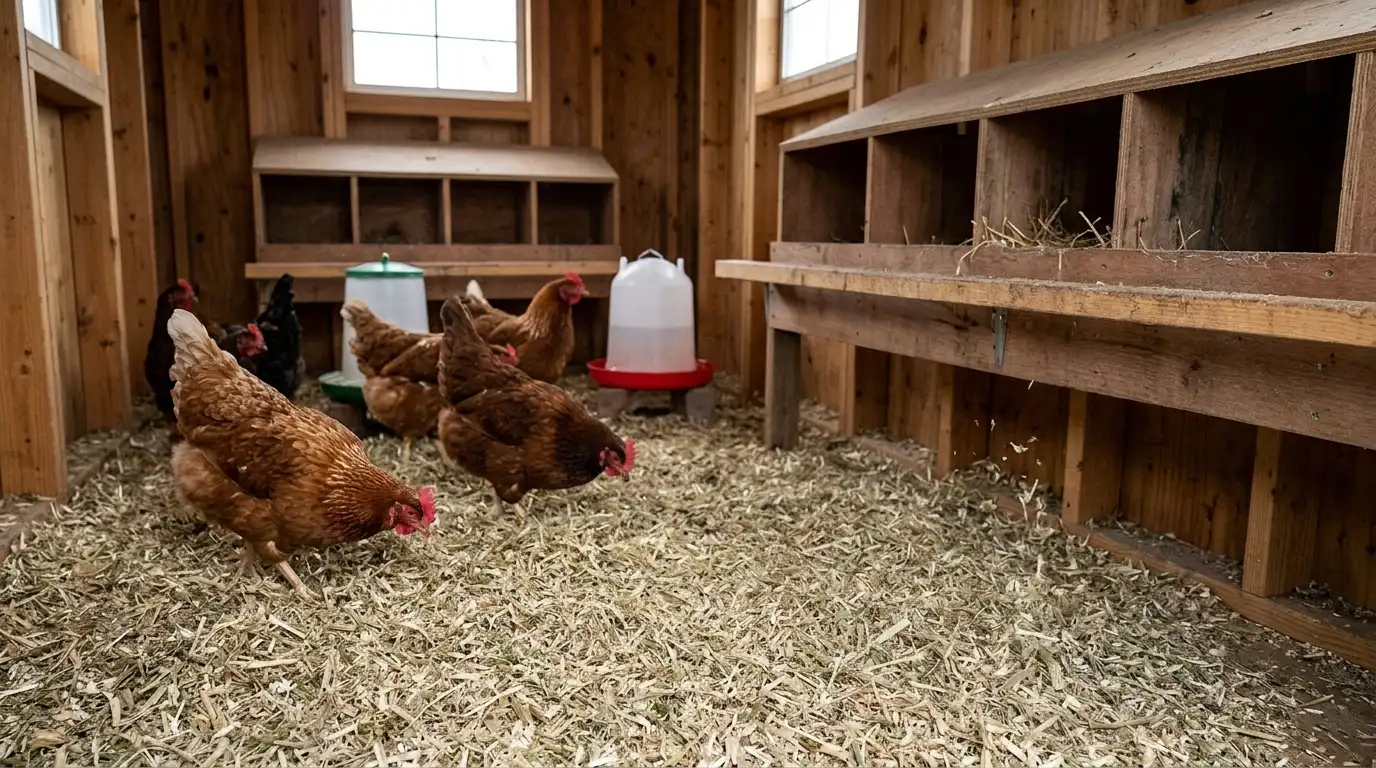
The first hard frost is a few weeks out. Your coop floor is about to become the most-used surface on the property, and right now it holds whatever was left over from spring. Six hens will spend twelve hours a night down there. They will drop on it, tip the waterer over on it, and breathe whatever rises off it.
That is the whole job of bedding. Soak up the moisture. Keep the ammonia down. Give the birds something dry to stand on. Get it wrong and you can smell the coop from the porch by December.
I started digging into this because our bag of shavings ran out on a Sunday and the feed store was closed. So I priced every hemp brand with an official store against shipped pine, farm-store bundles, straw, and pellets. Then I ran the math on a 4 by 8 floor, the size that fits six birds at our strict 4 square feet per bird standard.
Short answer: pine from a farm store if you can drive to one. Hemp if you are ordering online. Straw stays in the nest boxes. The reason is not the bag price. It is what a bag covers, and how often you have to change it.
Why the bag price misleads you
You stand in the aisle and compare a cheap bag of pine against a bag of hemp that costs twice as much. You take the pine. That comparison is wrong, because the two do not cover the same floor.
A bag that costs $30 and covers 60 square feet at a 2 inch depth costs less than half per square foot of a $36 bag that covers 30. Depth is the other half of the trap. A coop wants 2 to 3 inches to start. Shavings ship compressed, so the cubic-feet number on the label is what matters, not the size of the bag. Our coop size calculator turns your floor area into loose volume at 2 and 4 inches, which is how I got the fill counts below.
Then there is timing. A material that sogs out in three weeks costs twice what a six-week material costs per season, at the same sticker price.
Here is the whole board for a 32 square foot floor, priced per full fill.
| Material | Price (checked Oct 20) | Covers at 2 in | Per full fill, 4x8 floor |
|---|---|---|---|
| Hemp, Dominion 30 lb bag | $29.99 sale ($35.99 list) | ~60 sq ft (121 at 1 in) | ~$16 |
| Pine shavings, farm store | local price, varies | ~33 sq ft in a 5.5 cu ft bag | about the bag price |
| Pine shavings, shipped (Small Pet Select 141 L) | $35.99 | ~30 sq ft | ~$38 |
| Chopped straw (Standlee 25 lb) | dealer-priced | ~60 sq ft expanded | varies |
Row three is the one that stings. Shipped premium pine costs more than twice what the hemp costs per fill. The cheap bedding stops being the cheap choice the moment it has to travel. The hemp makers claim absorption around four times their own weight, which is the whole argument for paying more per bag.
How many fills a winter takes is the other half of the bill, and there is a rule for it further down.
If you are buying online, start here
Maybe there is no farm store within a reasonable drive. Maybe you want one bag that lives in the garage and gets ordered twice a winter. Then hemp is your answer, and the question becomes which bag.
Four brands run real official stores with published specs. I checked all four pages the same day. Prices move. The coverage math mostly does not.
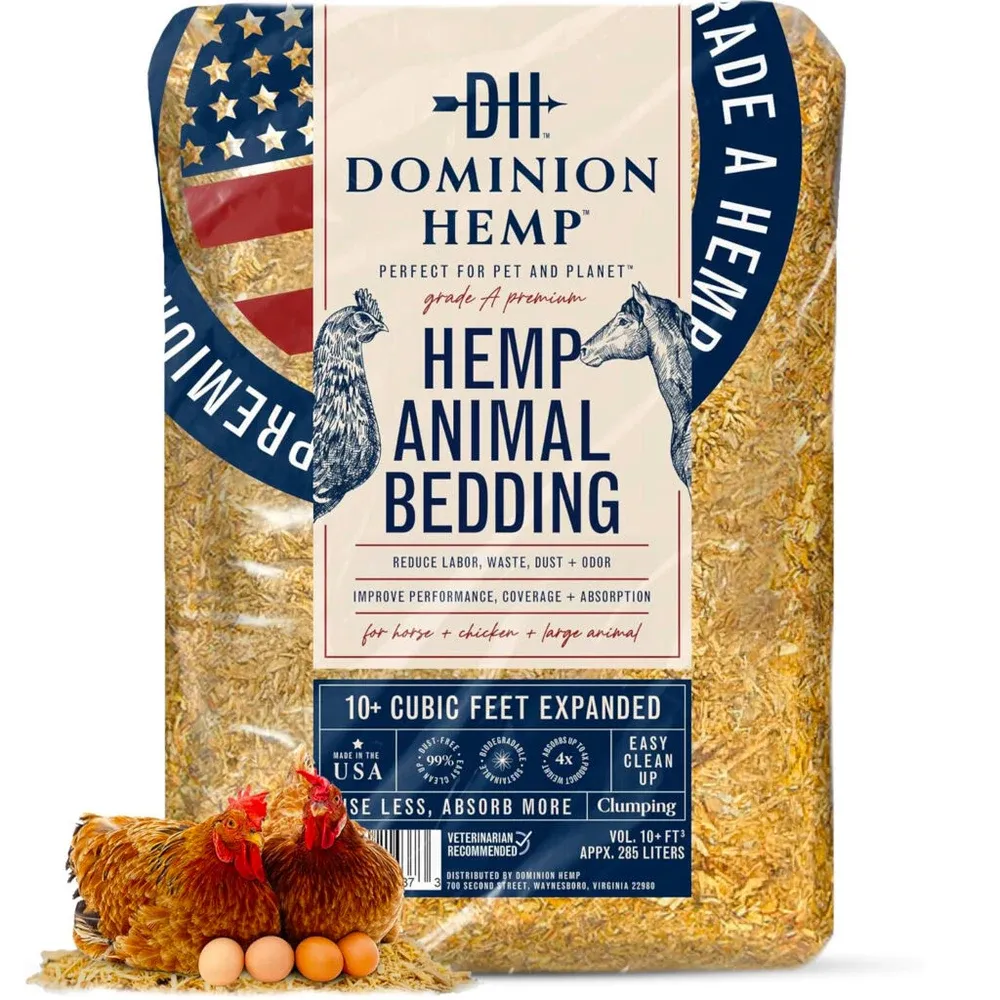
Dominion Hemp, Large 30 lb
at Dominion Hemp- Size
- 30 lb / 10+ cu ft
- Covers
- ~121 sq ft at 1 in
- Claim
- absorbs 4x its weight
- Rating
- 4.91 / 476 reviews
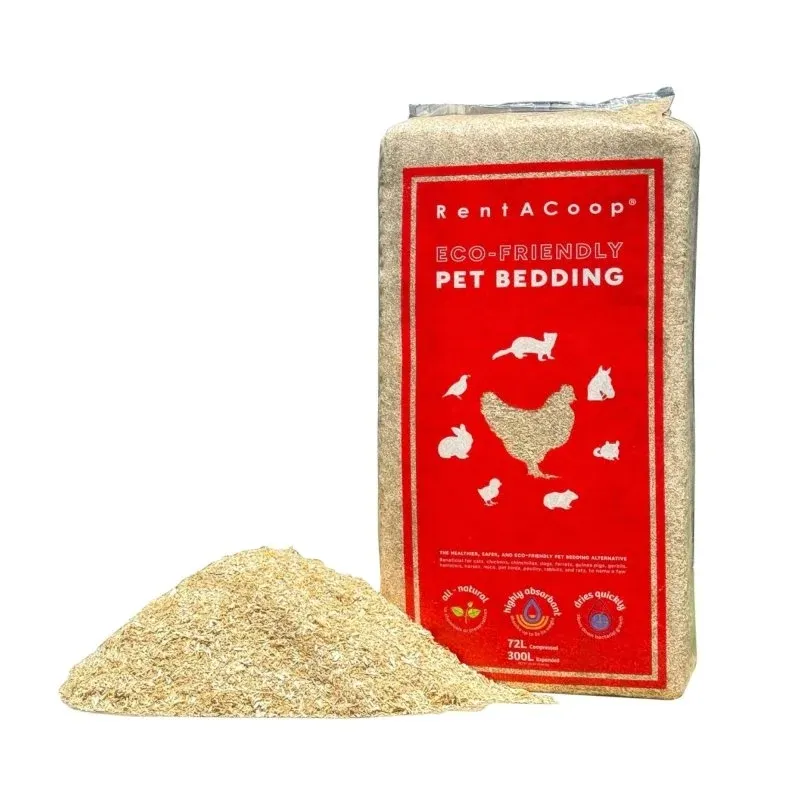
RentACoop Premium Hemp Bedding for Chickens 300L
at RentACoop- Size
- 30 lb / 300 L
- Covers
- ~60 sq ft at 2 in
- Expands to
- ~10.6 cu ft
- Dust
- low-dust formulation
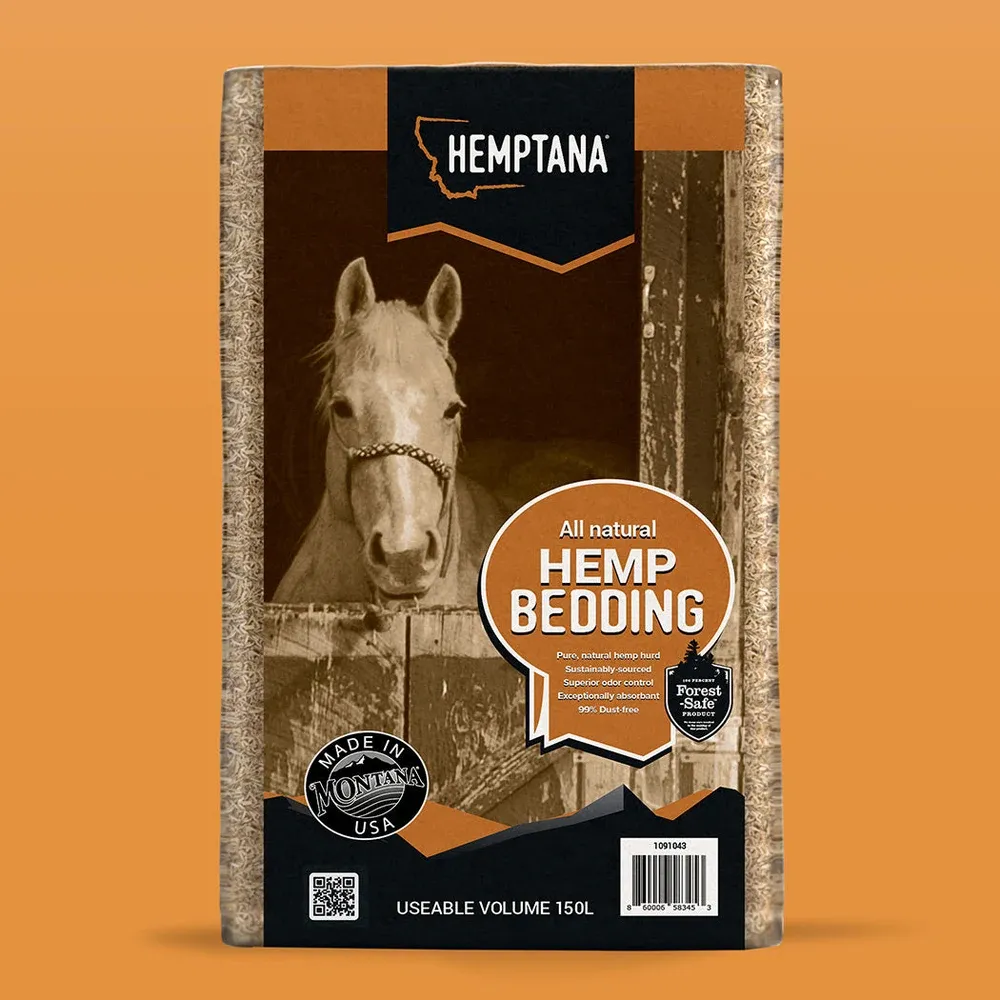
Hemptana Hemp Bedding for Horses and Livestock 150L
at Hemptana- Size
- 150 L (~5.3 cu ft)
- Covers
- ~32 sq ft at 2 in
- Claim
- absorbs 4x+ its weight
- Use list
- equine, poultry, livestock
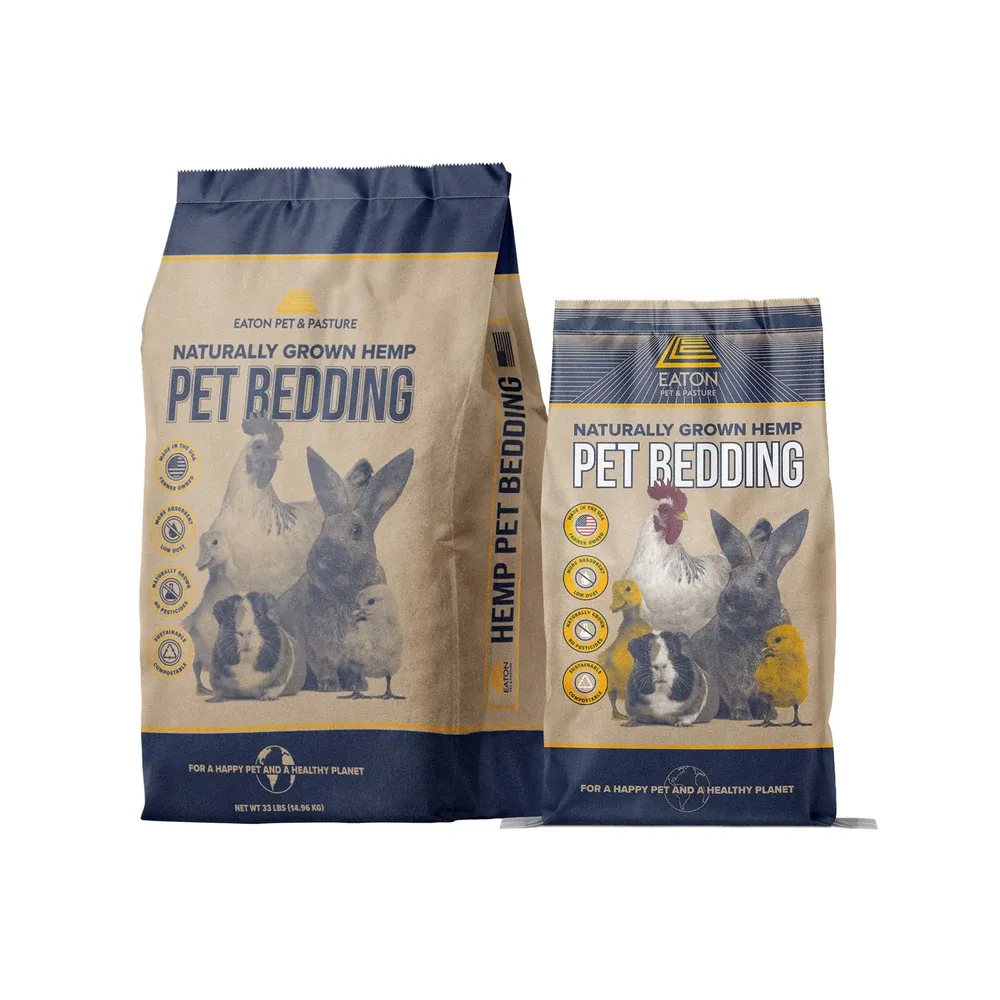
Eaton Hemp Bedding for Chicken Coops
at Eaton Pet & Pasture- Sizes
- 8 lb or 33 lb
- Origin
- US-grown
- Sold as
- chicken coop bedding
- Multi-pack
- 3 and 5 packs
Dominion is the one I would order. The reason is arithmetic. A $29.99 bag expands to about 121 square feet at an inch. At a real 2 inch depth that is 60, or near fifty cents a square foot. Once shipping is in the price, nothing else here beats it.
Two caveats. The 4.91 stars come from the maker’s own store, so read them as customer satisfaction, not testing. And the price is a sale. It may not hold.
RentACoop earns its place on supply, not price. At $74.95 it is the priciest bag here. But it cross-lists on Amazon, which makes it the practical pick for anyone who already buys coop supplies there. Its page also publishes the 60 square feet at 2 inches figure, the same math Dominion implies. The low-dust claim on the page is the same one hemp generally carries.
Hemptana is the odd one, and you should know it before you click. This is a horse-barn product. The bag art is a horse. The maker’s use list runs equine, poultry, livestock. Chickens are on the list, just not in the headline.
What it has going for it is fit. A 150 liter bale is almost exactly one full fill on a 4 by 8 floor, for $39.99. The maker claims absorption above four times its weight, and a dust-free process. If you want a bag that equals a change with no storage math, that is the shape to buy.
Eaton is where I would start if I wanted to test hemp without committing to bales. The 8 lb bag is $24.99. The 33 lb size is $84.99, the most expensive per pound here. Treat the small bag as the product and the big one as a convenience.
Pine, if you can drive to it
Here is where the whole comparison turns. Ordered online, hemp is the cheaper way to buy cubic feet of bedding. Dominion’s bag is 10-plus cubic feet for $29.99, about $3 a cubic foot. The premium pine I could price is 141 liters, about 5 cubic feet, for $35.99, or $7.20 a cubic foot.
Local pine is a different animal. Farm stores sell compressed shavings by the cubic foot, priced for barns rather than for coops. A 5.5 cubic foot bag covers a 4 by 8 floor at 2 inches with a little to spare. If you can drive to one, the shipped comparison stops mattering, and nothing online gets close. It is also the one route in this article I cannot quote you a number for, because your store sets it.
Two things do go wrong with pine. First, dust. Cheap shavings throw fine dust all winter, and that is hard on birds with touchy lungs and on whoever sweeps up. Kiln-dried shavings fix most of it for a dollar or two more.
Second, shipping. The moment pine has to travel, the math collapses, as the third row above shows. The only pine I found with a proper official store, Small Pet Select’s 141 liter chicken bedding at $35.99, costs more per fill than premium hemp. Their collection also carries hemp and wheat straw if you would rather order everything in one go.
Cedar is the one to skip. It sits beside the pine in the small-pet aisle and it smells great. The concern is the oils. An extension answer I found puts it carefully. The worry centers on chick bedding, where young respiratory systems are more fragile and chopped cedar releases its oils more readily. The expert’s advice is caution around young birds. With kiln-dried pine at bundle prices, I see no upside worth the risk at any age.
The specialists: straw, pellets, paper, sand
None of these belong on the main floor. Each one solves a smaller job well, and that is how to use them.
Straw is a nest box material. It is cheap locally, and it mats into a slick cap when it gets wet, which is why it does not belong on a wet floor. If your store carries bagged straw, Standlee’s certified chopped straw is the version worth knowing. It is a 25 lb bale, 2 cubic feet compressed and 10 expanded, about 60 square feet at 2 inches. Hay is a different thing. Hay is feed. Hay molds. Hay does not go on a coop floor.
Wood pellets are the answer for the droppings zone under the roost. They come in 40 lb bags, swell into sawdust when wet, and stay low-dust until they break down. Both stove pellets and stall pellets are compressed sawdust, so the hardware-store bag does the job for less. Check the label for plain wood with no accelerants.
Paper is a brooder answer. The small-pet kind, sold for rabbits and guinea pigs, is soft and nearly dust-free, which is why people put it under new chicks. It is a bad coop floor. Wet paper turns to pulp, and the bags are sized for hamster cages, not a 32 square foot floor. If a small pet already lives in your house, finish the bag under the chicks.
Sand is a hot-climate answer. It drains, it does not mold, and you scoop it like a cat box. In a northern winter it is worse than useless. Damp sand freezes into concrete in the month you need bedding most, and none of it composts. Our cold climate coop guide covers why winter floors want dry carbon instead.
How often do you have to change it?
This is the question every forum thread turns into an argument. One camp cleans weekly. One camp cleans twice a year. Someone always says never.
The best answer I found comes from University of Vermont extension guidance, which treats the coop as a slow compost pile. Start with 2 to 3 inches of bedding. Change it out when litter and manure reach about a fifty-fifty mix. In practice that lands every 2 to 4 weeks in the active season.
The same page gives you the field test. If the coop smells, it needs more bedding. Ammonia is moisture with no carbon left to soak it up.
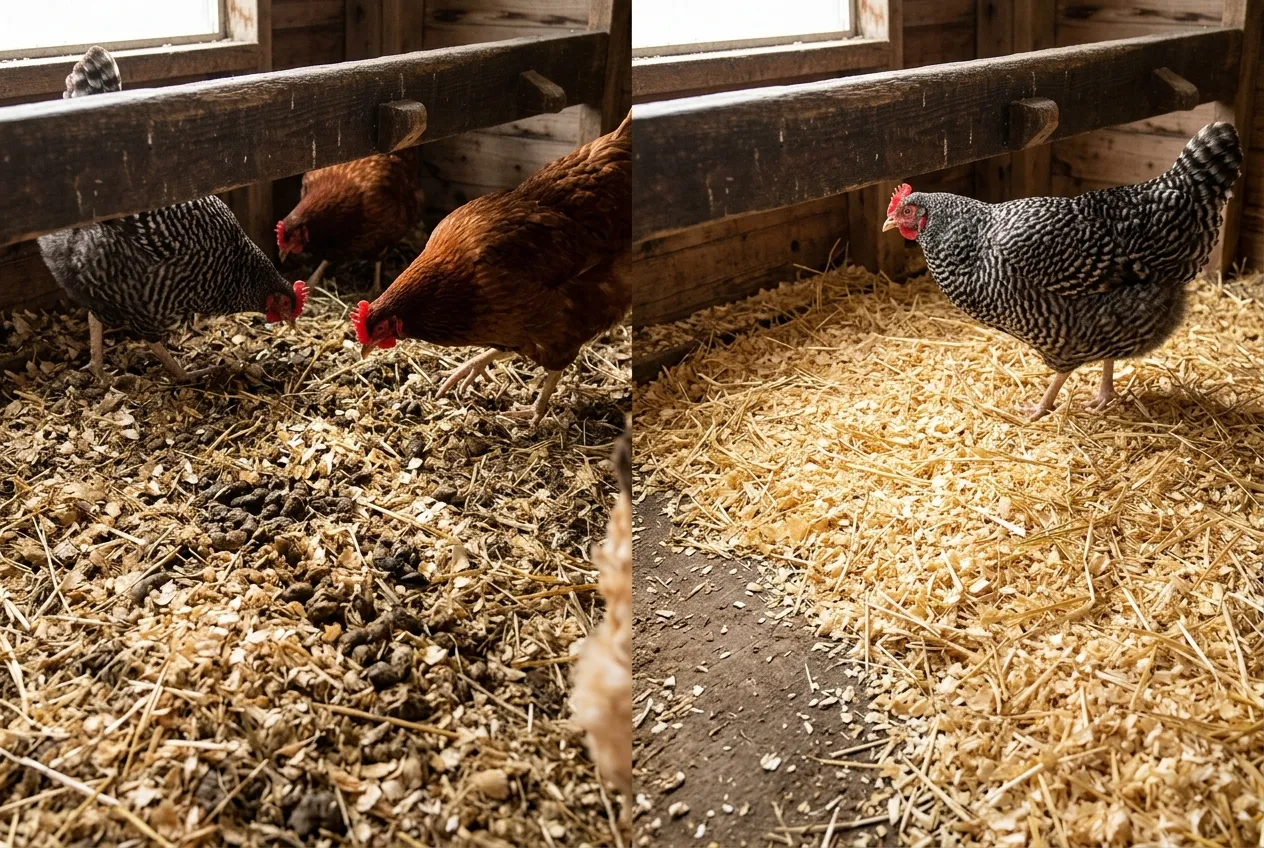
Day to day, that means two minutes under the roost with a scoop, which is a chore a six-year-old can own. Weekly, fluff the bed and top up the thin spots. The full change comes when the floor stops drying out between cleanings, not when a date says so.
For planning, treat that clock as real. Two to four weeks between full changes is the honest planning number for a small floor, and it is why the per-fill column matters more than the bag price. Multiply it by the number of changes you actually do, and you have your winter.
Deep litter, if your coop can take it
Every winter someone asks whether they can just keep piling bedding on and clean once in spring. Sometimes the answer is yes.
Vermont extension describes the method: about an inch a week through winter, holding that fifty-fifty balance so the floor keeps composting under the flock. It all comes out in spring for the garden. Your labor moves to spring, which makes it the cheapest winter regime there is.
The catch is the floor. Composting needs moisture and air to keep working. Seal that moisture against a wooden floor and you get rot instead of compost. That rules out most plywood and board floors, and it is why the method travels better with sealed plastic coops, which can run a shallow version with frequent dry-outs.
Whatever your floor, keep the ventilation real. Winter coop air has to move even when the thermometer argues otherwise. Our winter prep guide puts bedding in the seasonal order.
What I would do
For a 4 by 8 floor with no farm store nearby, I would order the Dominion bag. A full fill at 2 inches takes about half of it, so you are at roughly $16 a fill. Run that against your nose and the fifty-fifty rule, and reorder before you run out.
With a farm store in range, I would not order anything. A compressed bag at the counter covers the same floor, and the price difference is the reason this article exists.
Brooders are a separate job, and our brooder guide covers that setup.
The frost will decide for you in a few weeks. Better to have the bag on the shelf before it does.

Omlet Eglu Cube Review: What $1,399 Actually Buys
Omlet's Eglu Cube starts at $1,399 with no run, needs no maintenance, rolls on wheels, and handles winter. It's our standout pick in its price bracket.

What Killed My Chickens? A Guide to the Five Ways In
Predators get in five ways: dig, reach, squeeze, drop in, or work the latch. Read the signs, match the fix, one weekend at a time.