Do You Need a Chicken Coop Light for Winter Eggs?
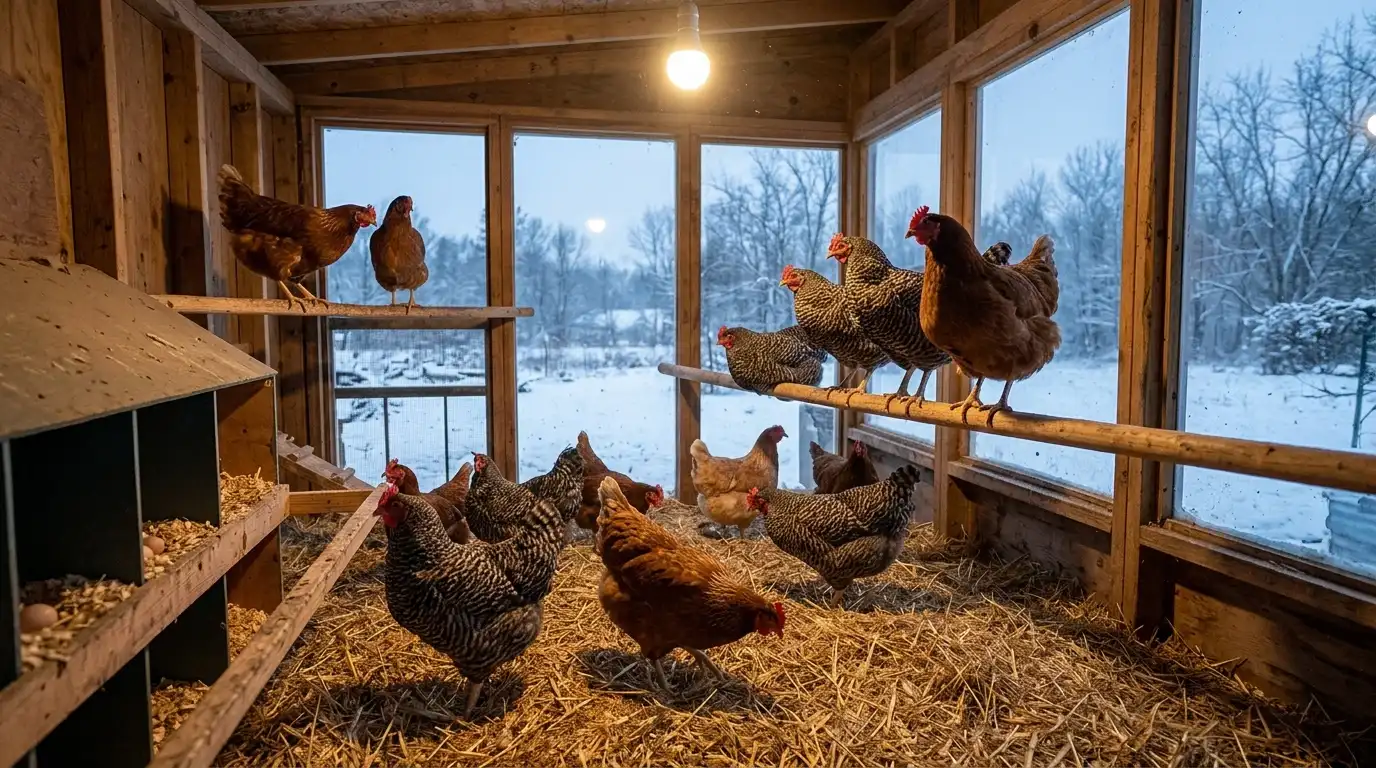
Every November the egg basket goes half empty, and every November the same argument restarts on the forums. One camp screws a bulb into the coop ceiling and gets eggs all winter. The other camp calls that burning your hens out and lets the flock rest until March. Both sound sure of themselves. Both can’t be reading the same biology.
I’ve spent this fall reading the extension lighting guides, the fire data, and enough keeper threads to lose a weekend, because I wanted the answer for our six hens before the solstice, not after. The short version: the light question has real numbers attached, the safety question has a real wrong answer, and the “burning through her eggs” argument everyone repeats is mostly a misread of the biology. Here is the whole decision.
Why the eggs stop (it isn’t the cold)
Chickens are long-season breeders. The eXtension laying-hen guide is blunt about the mechanism: hens “start producing eggs when there are more hours of light per day,” and decreases in daylength “typically will put a flock out of production.” The switch flips on daylength, not temperature. Your hens didn’t read a thermometer. They read the sky.
Penn State Extension pins the timing down. The drop toward winter begins “in September and October when the photoperiod reaches and dips below 12 hours per day,” which is also when the fall molt lands for many flocks. Two things stack: the shrinking day tells the ovary to slow down, and the molt pulls protein toward feathers instead of yolks. A hen mid-molt has a laying holiday coming regardless of what bulb you hang.
The cold itself is nearly a non-factor in this decision. Cold-hardy breeds in a dry, draft-managed coop keep laying through temperatures that would send you inside. We cover the cold tolerance story, and the ventilation that actually matters in winter, in our cold-climates coop guide and the winter ventilation piece. Light is the lever that moves winter eggs. The rest is plumbing.
One more piece of the biology, because it explains why a light works at all: a hen’s ovary is fully formed when she hatches and carries several thousand tiny ova, and the egg cycle itself takes a little more than 24 hours per egg, per Penn State’s hen reproduction primer. Laying is a daylight-gated production line, and the gate is the part you can control.
The two camps, honestly
This is a real fork, not a right answer hiding somewhere. Here’s what each side is actually signing up for.
Choose a heat plate when
- You want eggs through the winter and you'll take the small jobs that come with them: a timer to set, a bulb to dust off occasionally, one more electrical thing in the coop.
- Your flock isn't mid-molt, or has finished it. Light can hold a laying flock in lay; it can't hurry a molt that's already underway.
- You'd rather start before the lay drops, in early fall, ramping up slowly. Started late it still works, with more patience and fewer guarantees.
- You're done pretending store eggs are fine. Six hens, one $3 bulb, weekend breakfasts covered.
A heat lamp still makes sense when
- You keep chickens for the life of it, not the quota. Store eggs for twelve weeks costs less than any piece of coop gear you own.
- Your flock is molting now, is older, or came through a rough year. The molt is recovery time, and Penn State's own line is that it does not harm the birds to let it run naturally; they return to production in spring.
- You don't want one more wire, timer, or failure point in a wooden building, and you'd rather winterize the run and be done.
- You've read the burnout argument and it fits your philosophy: you are not chasing a dozen eggs a week from six tired hens.
The “burning through her eggs” argument, fact-checked
Here’s the claim you’ll meet in every light thread, usually in all caps: a hen is born with all the eggs she’ll ever have, so forcing winter lay burns through her lifetime supply and ends her laying years early.
The first half is true. The second half doesn’t follow, and the arithmetic is why. Penn State’s reproduction guide counts “several thousand” ova present in the ovary from hatching. A good hen lays a few hundred eggs in a whole life. Even a heavy production breed laying 300 eggs a year for three years doesn’t come close to emptying a reserve of several thousand. You cannot light your way through her ovarian reserve. The math isn’t close.
So if the reserve isn’t the problem, what’s the honest version of the rest camp’s worry? Body condition. Sustained output through winter, especially on a flock that just molted or is on thin feed, competes with condition and immunity. That’s a real welfare consideration, and it’s why the respectable answer isn’t “light is harmless.” It’s this: a healthy, finished-molt flock on good layer feed with a modest 14-hour day is within normal practice. And Penn State’s guidance explicitly says letting the flock molt and rest naturally does no harm either. Pick your camp with a clear conscience. Just stop citing the egg-count math, because it isn’t real.
If you add the light: the five settings that matter
Everything below is extension-checked, and none of it is expensive. Get these five right and the rest is details.
| Setting | The number | Why it’s that and not more |
|---|---|---|
| Day length | 14 h floor, 16 h cap | eXtension: at least 14 h holds a flock in lay. Penn State: aim for 16 h max, no more, and hens still need their dark period to sleep |
| Ramp speed | +1 h per week max | Faster shifts make birds “restless and flighty” and prone to pecking, per Penn State |
| Clock position | Early morning | Penn State: morning light, then natural sunset tells the birds when to come in and roost. Evening cutoffs strand birds off the roost in sudden dark |
| Brightness | 5 lux (about a 5–9 W LED per 100 sq ft) | Penn State: hens need a minimum of half a foot-candle to stay in lay, and bulbs that are too bright cause stress and pecking. Purina’s flock guide sizes it the same way: a 3–9 W LED or 25 W incandescent per 100 sq ft |
| Color | Warm white, under 3500 K | Penn State: chickens need orange and red wavelengths for reproduction. A “warm” household LED does this. A red heat lamp is not the safe way to get red light |
Fixture placement is the last real rule: mount it where birds “cannot jump on them or peck at them,” and check bulbs and wiring for dust buildup, per Penn State’s safety note. A dusty bulb also dims; five lux is a small ask, but it does have to actually reach the birds.
A timer or sensor earns its keep here. eXtension suggests a light sensor so the bulb doesn’t burn on bright mornings, which also happens to cut the already tiny electricity bill. A dusk-to-dawn LED bulb has the sensor built in and skips the timer entirely. Either path is fine; pick the one you’ll actually check on.
What a light will not fix
Set expectations before you buy the bulb, because winter has other ways to take your eggs:
- A molt in progress. Feather regrowth runs on protein and time. No schedule of hours fixes it. Feed the molt and wait.
- Frozen water. A hen that isn’t drinking isn’t laying, light or no light. This is a heated-waterer problem, and we solve it in the heated waterer guide.
- Thin feed. Scratch grains are a treat, not a laying ration. The winter feed question is its own project; the short answer is a proper layer feed and enough of it.
- Wrong arithmetic on flock size. If the real problem is that six hens can’t cover a family that eats eggs daily, the fix is flock planning, not photons. Run your numbers in the egg calculator before blaming the season.
The fire part, because it’s the one with a wrong answer
Winter is when animal-building fires happen, and the equipment that causes them is exactly what people used to hang as “coop lights.” NFPA’s Fire Protection Research Foundation review of animal housing fires put heating devices at the top of the causes it collected, 33% of fires, ahead of malfunctioning electrical systems at 29%, with incidents clustering in winter. There’s a code standard for animal housing life safety, NFPA 150, precisely because this class of building and this class of equipment burn.
So the rule is simple: the coop light is an LED bulb, not a heat lamp. A heat lamp is a 175–250 watt heater that happens to glow. The job here is five lux, which is one warm LED drawing single-digit watts, cool to the touch, cheap to run. We ran the full fire mechanism and the suspension rules in the heat plate vs heat lamp comparison; the short version for lighting is that a clamp lamp with a hot bulb over bedding is the single setup to never use as a light source.
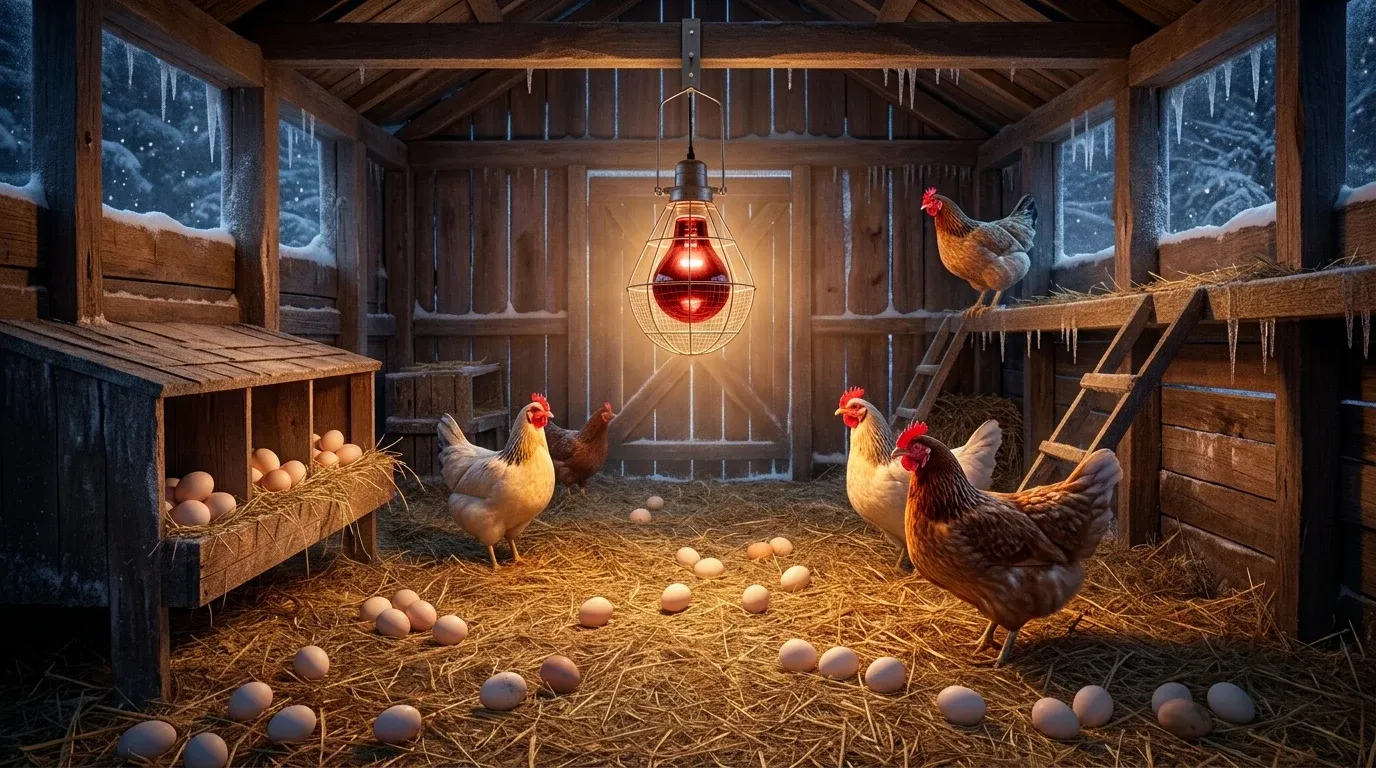
The rest of the electrical checklist is short. Hard-mount the fixture, keep cords out of beak range, keep the bulb dusted, and put the whole thing on a timer or sensor so it’s not dependent on you remembering. That’s the entire safety story for an LED setup, and it’s a much shorter story than the one for heat.
The whole setup, priced honestly
The electricity math first, because it settles the cost argument: a 9 W LED running 6 hours a day through a 120-day winter draws about 6.5 kWh. At roughly 15 cents a kWh, that’s about one dollar for the entire season. The bulb itself, a timer or sensor-equipped one, runs a few dollars and lasts years. There is no operating-cost argument against coop lighting. There just isn’t a number big enough to argue with.
The shopping list is three items, and none of them are sold as “chicken coop light” products, which you should skip on principle:
- A warm white LED bulb, dusk-to-dawn version. The built-in sensor handles the schedule, and warm-white household LEDs sit under 3500 K already. Check the color temperature on the package, not the marketing. Amazon’s dusk-to-dawn LED selection is a reasonable starting browse.
- A timer or smart plug, if you go with a plain bulb. A $10 mechanical timer is more reliable in a cold coop than it has any right to be, and it doesn’t need your wifi to reach the barn.
- A weather-rated fixture, if your coop doesn’t have one. Hard-mounted, beak-proof, and rated for damp locations. This is the one piece worth over-buying, because it’s the piece between a live wire and a wooden building full of dust and straw.
Skip anything marketed specifically as a chicken coop light with a brand premium on it. The hens cannot read the box. A $3 warm LED in a proper fixture hits every extension number above.
FAQ
These are the questions light threads actually get asked, not the ones lighting catalogs wish you asked.
Will a heat lamp work as the coop light?
No, and this is the one with a body count. Heating devices caused 33% of the animal housing fires NFPA’s research foundation collected, clustered in exactly the months you’d be running one. The lighting job needs five lux, which a single-digit-watt warm LED provides. A heat lamp is a heater that glows, not a light. Full mechanism and rules in our heat plate vs heat lamp piece.
Do red bulbs work better for laying?
The useful part of “red” is wavelength, and Penn State’s guidance is warm light under 3500 K, because chickens use orange and red wavelengths for reproduction cues. Any warm-white household LED covers that. A red heat lamp gets you the color with 250 watts of fire risk attached, which is the worst possible trade in this decision.
Can I just leave the coop light on 24/7?
No. Penn State caps the photoperiod at 16 hours and is explicit that hens still need a dark period, because they need sleep. A 24-hour day is also on the stress side of the ramp-speed rule, and it buys you nothing: production tops out well before the clock does.
It's already December and my hens stopped. Is it too late for a light?
Start one now if you want, but ramp slowly, no more than an extra hour per week, and hold expectations. If the flock molted in fall, some of them may not resume until days lengthen in late winter no matter what the bulb says. Light works best started before the lay drops. Started in December it’s a maybe, and it’s never a refund.
Will a winter light hurt my hens long-term?
The version to stop repeating is the egg-count one: hens hatch with several thousand ova and lay a few hundred eggs in a lifetime, so winter light rearranges the schedule rather than draining the reserve. The real considerations are condition and timing. A healthy finished-molt flock on good feed with a 14-hour day is normal practice, and letting the flock rest the winter is equally defensible. Neither camp gets to claim the other is hurting birds.
Now, about that November basket. Whether it fills back up is a choice you get to make with the numbers in front of you, which is more than most winter coop decisions offer. Pick your camp, and mount the bulb properly if you’re in ours. The sky handles the rest of the work either way.
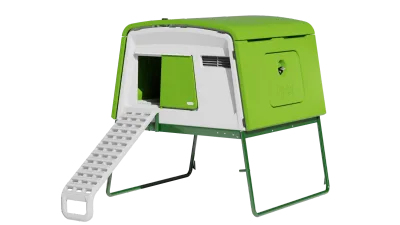
Omlet Eglu Cube Review: What $1,399 Actually Buys
Omlet's Eglu Cube starts at $1,399 with no run, needs no maintenance, rolls on wheels, and handles winter. It's our standout pick in its price bracket.
What Killed My Chickens? A Guide to the Five Ways In
Predators get in five ways: dig, reach, squeeze, drop in, or work the latch. Read the signs, match the fix, one weekend at a time.